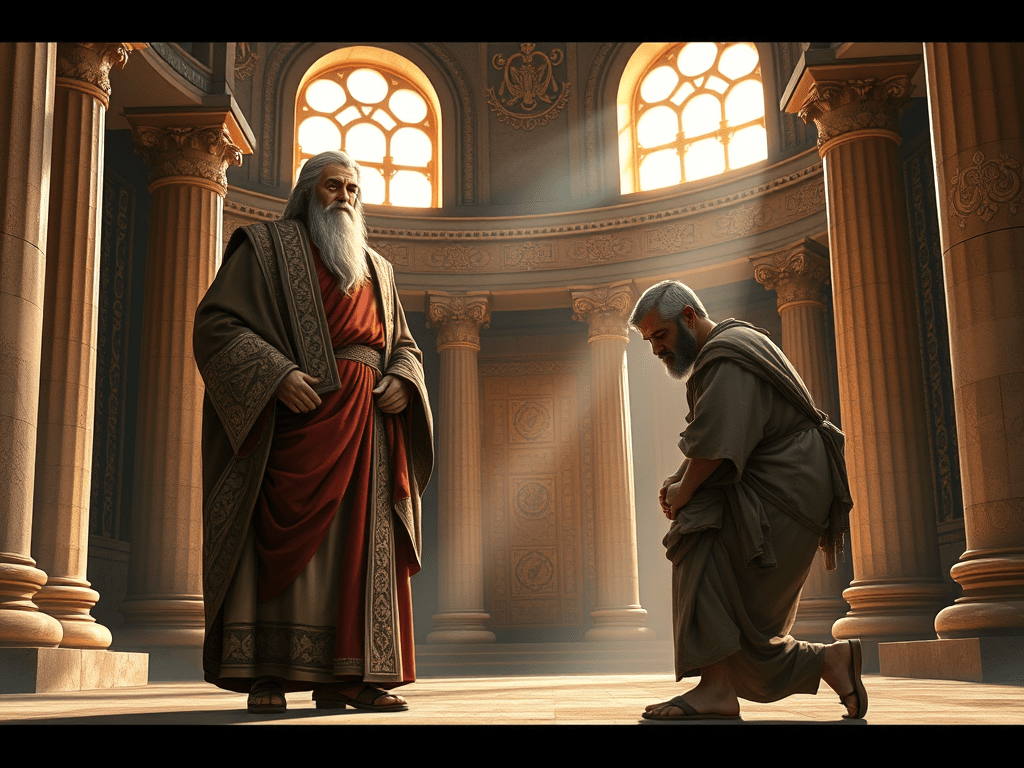
Micah: Walking Humbly with God

After Jonah’s story of reluctant obedience and God’s boundless compassion, I turned to Micah. His words felt like a sharp, clear trumpet blast cutting through the fog of ritual and religion. Micah doesn’t mince words—he confronts injustice, calls out hypocrisy, and reminds me of what God truly desires. Reading Micah was like being stripped of excuses and brought back to the heart of faith.

Confronting Injustice

Micah lived in a time when leaders exploited the poor, prophets spoke for profit, and worship was hollow. His words hit me hard because they sound so familiar.

“Hear this, I pray you, ye heads of the house of Jacob, and princes of the house of Israel, that abhor judgment, and pervert all equity.” (Micah 3:9, KJV)

I couldn’t help but think about the ways I sometimes ignore injustice around me. Micah reminded me that faith isn’t just personal—it’s social. God cares about how I treat others, especially the vulnerable. His rebuke challenged me to examine whether my life reflects justice or selfishness.

God’s Requirements Made Simple

The verse that defines Micah—and has defined much of my walk with God—is Micah 6:8.

“He hath shewed thee, O man, what is good; and what doth the LORD require of thee, but to do justly, and to love mercy, and to walk humbly with thy God?” (KJV)

I remember reading that and feeling both convicted and freed. Convicted, because I often complicate faith with rituals, rules, and appearances. Freed, because God’s requirements are simple and profound: justice, mercy, humility. Micah taught me that true worship isn’t about performance—it’s about how I live every day.

Hope in the Coming King

Micah doesn’t just rebuke—he also offers hope. In the midst of judgment, he prophesies about a ruler to come from Bethlehem.

“But thou, Bethlehem Ephratah, though thou be little among the thousands of Judah, yet out of thee shall he come forth unto me that is to be ruler in Israel; whose goings forth have been from of old, from everlasting.” (Micah 5:2, KJV)

Reading that, I was reminded that God’s plan has always been redemption. Even in the darkest times, He points to Christ, the humble King born in Bethlehem. Micah’s prophecy reassured me that God’s justice is always paired with His mercy, and His promises never fail.

Lessons for My Life

Micah’s words continue to shape me in practical ways:

  • Justice matters: How I treat others reflects my faith.
  • Mercy is essential: Compassion is not optional—it’s central to God’s heart.
  • Humility is the posture of faith: Walking with God means surrendering pride.
  • Hope is certain: God’s promises point to Christ, the everlasting ruler.

Conclusion

Micah stripped away my excuses and reminded me of the simplicity of God’s call. To do justly, to love mercy, to walk humbly—that’s the essence of faith. His words challenge me to live beyond ritual, to embody compassion, and to anchor my hope in Christ.

Reading Micah felt like being confronted with truth, but also being invited into a life of integrity and humility. It’s a call I need to hear again and again.

Discovering the Path of Salvation Series

Jonah: Learning Obedience and Compassion

Continuing in the minor prophet’s series: Lessons from the Minor Prophet’s. When I turned from Hosea to Jonah, I expected another heavy prophetic book filled with warnings and judgment. Instead, I found myself staring into a mirror of my own reluctance. Jonah’s story isn’t long, but it is piercing. It’s about obedience, compassion, and the uncomfortable truth that God’s mercy extends far beyond my preferences.

Running from God’s Call

I can’t read Jonah without feeling a pang of recognition. God told Jonah to go to Nineveh, but Jonah fled in the opposite direction.

“But Jonah rose up to flee unto Tarshish from the presence of the LORD, and went down to Joppa; and he found a ship going to Tarshish: so he paid the fare thereof, and went down into it, to go with them unto Tarshish from the presence of the LORD.” (Jonah 1:3, KJV)

I’ve had moments where God nudged me toward something uncomfortable—speaking truth, showing kindness, stepping into a place I didn’t want to go—and I resisted. Jonah’s flight reminded me that disobedience isn’t just about breaking rules; it’s about running from God’s presence.

God’s Mercy in the Storm

Even in Jonah’s rebellion, God pursued him. The storm, the sailors, the great fish—all of it was God’s mercy, not punishment.

“Now the LORD had prepared a great fish to swallow up Jonah. And Jonah was in the belly of the fish three days and three nights.” (Jonah 1:17, KJV)

That verse always amazes me. The fish wasn’t Jonah’s destruction—it was his salvation. Sometimes God’s mercy looks like confinement, like being hemmed in, but it’s really His way of rescuing me from myself. Jonah taught me that God’s discipline is often His mercy in disguise.

Nineveh’s Repentance

When Jonah finally obeyed, Nineveh responded with repentance.

“So the people of Nineveh believed God, and proclaimed a fast, and put on sackcloth, from the greatest of them even to the least of them.” (Jonah 3:5, KJV)

I’m humbled by this. Jonah’s reluctant obedience still bore fruit. It reminds me that God’s power doesn’t depend on my enthusiasm—His Word carries authority even when I deliver it imperfectly. Jonah showed me that obedience, even reluctant, can open the door for God’s mercy to transform lives.

God’s Compassion Beyond My Comfort

The part of Jonah that convicts me most is the ending. Jonah was angry that God spared Nineveh. He wanted judgment, not mercy. But God’s heart was clear:

“And should not I spare Nineveh, that great city, wherein are more than sixscore thousand persons that cannot discern between their right hand and their left hand; and also much cattle?” (Jonah 4:11, KJV)

That verse challenges me. God’s compassion is wider than my prejudices, deeper than my sense of justice. Jonah reminds me that obedience isn’t just about doing what God says—it’s about aligning my heart with His mercy. If I obey outwardly but resist inwardly, I miss the fullness of His call.

Lessons for My Life

Jonah’s story continues to shape me in profound ways:

  • Running from God is futile: His presence pursues me even when I resist.
  • God’s discipline is mercy: The storms and confinements in my life may be His rescue.
  • Obedience bears fruit: Even reluctant obedience can be used by God.
  • God’s compassion is greater than mine: His mercy extends to those I might deem undeserving.

Conclusion

Jonah taught me that obedience is more than action—it’s surrendering my heart to God’s compassion. His story reminds me that God’s mercy is not limited by my preferences, and His love reaches even those I would overlook.

Reading Jonah felt like being confronted with my own reluctance, but also being invited into God’s expansive mercy. It’s a call to obey, to trust, and to let my heart be reshaped by His compassion.

Discovering the Path of Salvation Series

Hosea: Discovering God’s Relentless Love

Continuing the study in minor prophets: Lessons in the Minor Prophets.

When I first opened the book of Hosea, I didn’t expect it to pierce my heart the way it did. Hosea is often overlooked, tucked away among the Minor Prophets, but his story is anything but minor. It is raw, painful, and yet profoundly beautiful. Hosea’s life became a living parable of God’s covenant love—a love that refuses to let go even when betrayed.

A Marriage That Preaches

God commanded Hosea to marry Gomer, a woman who would be unfaithful. At first, I struggled with this. Why would God ask His prophet to endure such heartbreak? But as I read, I realized Hosea’s marriage was meant to mirror Israel’s relationship with God. Just as Gomer strayed, Israel chased after idols. And just as Hosea pursued her, God pursued His people.

“And the LORD said unto me, Go yet, love a woman beloved of her friend, yet an adulteress, according to the love of the LORD toward the children of Israel, who look to other gods, and love flagons of wine.” (Hosea 3:1, KJV)

That verse struck me deeply. Hosea’s love was not based on Gomer’s faithfulness—it was based on God’s command to reflect His own relentless love. In that moment, I saw myself in Gomer. I’ve wandered, I’ve chased after lesser loves, and yet God has never stopped pursuing me.

God’s Call to Return

Throughout Hosea, the theme of returning to God echoes again and again. Israel’s sin was real, but so was God’s mercy.

“O Israel, return unto the LORD thy God; for thou hast fallen by thine iniquity.” (Hosea 14:1, KJV)

I’ve felt the weight of my own failures, the shame of falling short. Yet Hosea reminded me that God’s invitation is always open. He doesn’t say, “Clean yourself up first.” He simply says, “Return.” That call is both humbling and liberating. Repentance isn’t about earning forgiveness—it’s about receiving the love that’s already waiting.

Healing and Free Love

One of the most powerful promises in Hosea comes near the end:

“I will heal their backsliding, I will love them freely: for mine anger is turned away from him.” (Hosea 14:4, KJV)

That word “freely” leapt off the page. God’s love isn’t reluctant or begrudging—it’s abundant, unearned, and overflowing. I realized that when I return to Him, He doesn’t just forgive; He heals. He restores what was broken. Hosea taught me that God’s love is not fragile—it is fierce, pursuing, and unrelenting.

Mercy Over Ritual

Another verse that challenged me was Hosea 6:6:

“For I desired mercy, and not sacrifice; and the knowledge of God more than burnt offerings.” (KJV)

It’s easy to fall into the trap of outward religion—checking boxes, performing rituals, or even just “going through the motions.” But Hosea reminded me that God isn’t impressed by empty gestures. He desires mercy, compassion, and genuine relationship. This verse forced me to ask: Am I living out my faith in love and mercy, or am I just performing for appearances?

Lessons for My Life

Walking through Hosea, I learned several lessons that continue to shape my faith:

  • God’s love is relentless: Even when I stray, He pursues me.
  • Repentance is an invitation: Returning to God is always possible, no matter how far I’ve wandered.
  • Healing is promised: God doesn’t just forgive—He restores.
  • Faith is relational: He desires mercy and knowledge of Him more than ritual.

Hosea’s story is not just ancient history—it’s a living testimony that even in my unfaithfulness, God remains faithful.

Conclusion

Hosea taught me that God’s love is not conditional on my perfection. It is steadfast, pursuing, and healing. His call is always to return, His mercy is always greater than my failures, and His desire is always for relationship rather than ritual.

Reading Hosea felt like being confronted by a mirror—seeing my own wandering heart—but also being embraced by a Father whose love refuses to let go.

Discovering the Path of Salvation Series

Lessons from the Minor Prophets: A Personal Journey

When I first began reading through the Minor Prophets, I confess I didn’t expect much. They’re tucked away at the end of the Old Testament, often overshadowed by the grandeur of Isaiah or the wisdom of Jeremiah. Yet as I journeyed through Hosea to Malachi, I found myself confronted, comforted, and challenged in ways I hadn’t anticipated. These short books, though “minor” in length, are major in their message.

Hosea: God’s Relentless Love

I remember sitting with Hosea’s story and feeling the weight of God’s love for His people. Hosea’s marriage to Gomer was a living parable of Israel’s unfaithfulness, and yet God’s mercy shone through.

“I will heal their backsliding, I will love them freely: for mine anger is turned away from him.” (Hosea 14:4, KJV)

Reading that, I realized how often I’ve strayed, and yet the Lord continues to call me back. Hosea taught me that God’s love is not conditional on my perfection—it is steadfast, pursuing, and healing.

Jonah: Obedience and Compassion

Jonah’s reluctance resonated with me more than I’d like to admit. I’ve had moments where God nudged me toward uncomfortable obedience, and I resisted. Jonah’s story reminded me that God’s compassion extends even to those I might deem undeserving.

“And should not I spare Nineveh, that great city, wherein are more than sixscore thousand persons that cannot discern between their right hand and their left hand; and also much cattle?” (Jonah 4:11, KJV)

This verse convicted me: God’s mercy is wider than my prejudices. Jonah taught me that obedience isn’t just about duty—it’s about aligning my heart with God’s compassion.

Micah: What God Requires

Micah’s words cut through the noise of ritual and religion, reminding me of the simplicity of God’s call.

“He hath shewed thee, O man, what is good; and what doth the LORD require of thee, but to do justly, and to love mercy, and to walk humbly with thy God?” (Micah 6:8, KJV)

I often complicate faith, but Micah brought me back to the basics: justice, mercy, humility. These aren’t lofty ideals—they’re daily practices. Micah taught me that true worship is lived out in how I treat others.

Habakkuk: Faith in Uncertainty

Habakkuk’s dialogue with God felt like my own prayers in seasons of doubt. He questioned, wrestled, and waited. Yet his conclusion was one of trust.

“Although the fig tree shall not blossom, neither shall fruit be in the vines… Yet I will rejoice in the LORD, I will joy in the God of my salvation.” (Habakkuk 3:17–18, KJV)

Habakkuk taught me that faith isn’t the absence of questions—it’s choosing joy in God even when circumstances are bleak.

Malachi: Returning to God

Finally, Malachi confronted me with the call to return. His words reminded me that God desires not half-hearted devotion but wholehearted worship.

“Return unto me, and I will return unto you, saith the LORD of hosts.” (Malachi 3:7, KJV)

Malachi taught me that repentance is not a one-time act but a continual turning back to God, a daily reorientation of my heart.

Conclusion

Walking through the Minor Prophets has been like sitting with wise mentors who speak hard truths wrapped in divine love. Hosea showed me God’s relentless love, Jonah His boundless compassion, Micah His simple requirements, Habakkuk His call to faith, and Malachi His invitation to return.

Though these prophets lived centuries ago, their voices echo into my life today, reminding me that God’s Word is living, sharp, and deeply personal.

I will be following up this post with a more in-depth post from each of the books from my personal study and devotions.

If you like what you read may I suggest you check out my books: Discovering the Path of Salvation series

Small Group Study: Holding Fast to Truth

This study using information from the Blog Post: Enduring Belief: The Japanese Soldier and Biblical Faith

Opening Thought

In 1972, Hiroo Onoda, a Japanese soldier, was found still believing World War II was ongoing. His conviction sustained him, but it was misplaced. This story challenges us to consider: What is the foundation of our belief? The Bible calls us to anchor our faith in God’s eternal truth.

Scripture Focus

  • 2 Corinthians 5:7 – “For we walk by faith, not by sight.”
  • 1 Corinthians 15:58 – “Be ye steadfast, unmoveable, always abounding in the work of the Lord.”
  • John 17:17 – “Sanctify them through thy truth: thy word is truth.”
  • John 8:32 – “And ye shall know the truth, and the truth shall make you free.”
  • Psalm 119:105 – “Thy word is a lamp unto my feet, and a light unto my path.”
  • Isaiah 40:8 – “The grass withereth, the flower fadeth: but the word of our God shall stand for ever.”

Discussion Guide

1. The Power of Belief

  • Story Connection: Onoda’s loyalty kept him alive, but it was directed toward a war that had ended.
  • Bible Connection: Faith sustains believers, but it must be rooted in eternal truth.

Questions:

  • What are examples of beliefs that people hold today that may be misplaced?
  • How does faith in God differ from Onoda’s faith in his mission?

2. Setting Your Truth vs. Living God’s Truth

  • Cultural Idea: “Set your truth” often means defining reality for yourself.
  • Biblical Idea: Truth is not self-made; it is revealed by God’s word.

Questions:

  • How does John 17:17 challenge the idea of “my truth”?
  • What dangers arise when truth is defined individually rather than by God?

3. Conviction Anchored in Eternity

  • Onoda’s Conviction: Admirable perseverance, but misaligned with reality.
  • Christian Conviction: Anchored in Christ, who is eternal.

Questions:

  • What does Hebrews 12:2 teach us about where conviction should be placed?
  • How can we remain “steadfast, unmoveable” in a world that questions faith?

4. Living Out Truth

  • Practical Application: Truth is not just believed—it is lived daily.
  • Scripture: Psalm 119:105 shows truth guiding our steps.

Questions:

  • What does it look like to live out truth in everyday decisions?
  • How can we encourage one another to walk in God’s truth consistently?

Group Activity

  • Reflection Exercise: Write down one belief or conviction you hold strongly. Discuss whether it is rooted in God’s word or personal preference.
  • Application Challenge: This week, choose one scripture from the study to memorize and apply in a practical situation.

Closing Prayer

Pray for discernment to distinguish between misplaced beliefs and eternal truth, and for strength to walk faithfully in God’s word.

Enduring Belief: The Japanese Soldier and Biblical Faith

The Soldier Who Never Surrendered

In 1972, the world was astonished when Hiroo Onoda, a Japanese intelligence officer, was found in the Philippine jungle still convinced that World War II had not ended. For nearly three decades, he lived in hiding, carrying out orders, and resisting surrender. His loyalty was absolute, even though the war had long since concluded. To him, the world outside was mistaken; his mission was clear, and he clung to it with unwavering conviction.

Onoda’s story is often told as a tale of misplaced faith—devotion to a cause that no longer existed. Yet it also reveals the power of belief: how it can sustain a person through isolation, hardship, and doubt.

The Bible and Enduring Belief

In a similar way, belief in the Bible persists across centuries. Skeptics may argue that faith in scripture is outdated, much like Onoda’s adherence to his wartime orders. Yet for believers, the Bible is not a relic of the past but a living word that continues to shape lives today.

The Apostle Paul wrote:

“For we walk by faith, not by sight” (2 Corinthians 5:7, KJV).

Just as Onoda lived by unseen orders, Christians live by faith in promises not yet fully realized. The difference, however, is profound: Onoda’s mission was based on a war that had ended, while the believer’s mission is rooted in eternal truth.

Conviction in the Face of Doubt

Onoda’s refusal to surrender mirrors the steadfastness urged in scripture:

“Be ye steadfast, unmoveable, always abounding in the work of the Lord” (1 Corinthians 15:58, KJV).

His loyalty, though misplaced, demonstrates the human capacity for perseverance. Likewise, Christians are called to hold fast to the faith, even when the world insists it is obsolete.

The Key Difference

The crucial distinction lies in the object of belief. Onoda’s devotion was admirable but tragically misaligned with reality. The Bible, however, points to a truth that transcends time:

“The grass withereth, the flower fadeth: but the word of our God shall stand for ever” (Isaiah 40:8, KJV).

Where Onoda’s orders expired with the war, God’s word endures eternally. Faith in scripture is not clinging to a bygone cause but anchoring oneself in promises that remain unbroken.

Conclusion

The story of Hiroo Onoda reminds us of the strength of conviction and the dangers of misplaced faith. It challenges us to ask: What is the foundation of our belief? The Bible calls believers to a faith that is not outdated but everlasting, rooted in the eternal word of God.

“Jesus Christ the same yesterday, and to day, and for ever” (Hebrews 13:8, KJV).

Onoda’s life shows the power of belief to sustain. The Bible shows the power of belief to save.

For deeper and further understanding, check out my books: Discovering the Path of Salvation Series

Biblical Frequencies: Sound and Spirituality in Scripture

Of late, I have been questioned on my belief of the use of frequencies being Biblical and not “new age”. Yes, the Bible does mention “frequencies” in a literal, numerical sense quite often—though almost always in a musical or vibrational context rather than modern New Age “energy frequency” ideas. Here are the main places where the concept of frequency (repeated sounds, vibrations, or regular occurrences) appears:

1. Musical frequencies / pitch in the Old Testament (Hebrew)

The Hebrew word תֹּךְ (tōk) and especially the noun תְּקוּעָה (tequʿah) and verb תָּקַע (taqaʿ) are repeatedly used for trumpet blasts and their specific rhythmic or frequency patterns:

  • Numbers 10:3–10 describes different “frequencies” of trumpet sounds (long steady blasts vs. short rapid blasts) that had distinct meanings:
    • One long blast = assemble the whole congregation
    • Multiple short, rapid blasts = signal the camps to march
    • These are literally different acoustic frequencies and cadences that the priests had to produce precisely.
  • Joshua 6 (fall of Jericho): the priests marched seven days, and on the seventh day they circled seven times and gave a “long blast” followed by a great shout. Again, very specific sound frequencies and timing.
  • Psalm 150 mentions many instruments with specific pitches and timbres (cymbals that are “loud” vs. “high-sounding,” etc.).

2. The “voice” of God as a frequency or resonance

  • Exodus 19:16–19 at Mount Sinai: thunder, lightning, a “very loud trumpet blast” that grew louder and louder—an increasing frequency/intensity of sound that made the people tremble.
  • Ezekiel 1 and 10, Revelation 1 and 4: the “sound of many waters,” wings of the living creatures making a sound “like the roar of rushing waters” or “like a mighty army”—ancient way of describing very high-amplitude, multi-frequency sound.

3. New Testament: the Greek word for “frequency” in worship

  • Hebrews 10:25 uses the phrase μὴ ἐγκαταλείποντες τὴν ἐπισυναγωγὴν ἑαυτῶν (“not forsaking the assembling of ourselves together”). While not musical, some modern charismatic teachers stretch this into a “frequency of gathering” idea.
  • Revelation 14:2: John hears a sound from heaven “like the roar of rushing waters and like a loud peal of thunder… like that of harpists playing their harps”—again, layered acoustic frequencies.

4. Modern “vibrational frequency” interpretation (not in the text itself)

Many New Age or Word-of-Faith teachers claim the Bible teaches that everything vibrates at certain spiritual frequencies (citing verses about praise, joy, or the “sound” of heaven). While the Bible does connect sound, music, and spiritual power (walls of Jericho falling, David’s harp driving out evil spirits in 1 Samuel 16:23, Paul and Silas’s singing opening prison doors in Acts 16), the original texts are talking about literal audible sound and its emotional/spiritual effects—not quantum vibration or Hertz measurements.

Summary

Yes, the Bible repeatedly mentions specific sound frequencies:

  • Trumpet blast patterns (different cadences/frequencies for different commands)
  • Increasing intensity of divine sound (Sinai, Ezekiel, Revelation)
  • Music and harmonic resonance as a spiritual weapon

But no, it never uses the modern concept of everything in creation having a measurable Hertz frequency that you can “raise” through thoughts or words. That idea comes from 20th-century New Thought and New Age teaching, not the biblical text itself. It can be easy to get lost in translation and step beyond the boundary of God’s intention.

The Real History of Christmas (How an Ancient Christian Holy Day Became the Holiday We Know Today)

Christmas is so woven into our culture that it feels timelessly appears. Yet the holiday we celebrate on December 25—with trees, lights, gifts, carols, and Santa Claus—took nearly 2,000 years, several continents, and a surprising amount of controversy to reach its modern form.

Here is what I understand to be the true story, told in chronological order.

1st–3rd Centuries: No Christmas Yet

The earliest Christians did not celebrate Jesus’ birth at all. The New Testament never records the date, and the apostolic church focused its calendar on Easter (the death and resurrection). Birthdays in general were viewed with suspicion because pagan emperors celebrated theirs with excessive pomp.

Early church fathers (Origen (c. 245 AD) even mocked the idea of celebrating Christ’s birth as something only pagans and heretics would do.

4th Century: The First Christmas (December 25, 336 AD)

The first recorded celebration of Christ’s birth on December 25 occurred in Rome in AD 336, during the reign of Emperor Constantine. Why December 25?

Two main theories (both probably true):

  1. The “Calculation Hypothesis” – Early theologians tried to work out the date of Jesus’ conception from the supposed date of Zechariah’s temple service (Luke 1) and the belief that great prophets died on the same day they were conceived. This placed the Annunciation (and thus conception) on March 25, making birth nine months later—December 25.
  2. The “Christianizing Pagan Festivals” Hypothesis – December 25 was already the Roman feast of Sol Invictus (“Unconquered Sun”), instituted by Emperor Aurelian in 274. Christians may have deliberately chosen the same day to proclaim that Jesus, not the sun, is the true “Light of the World” (John 8:12 KJV).

By 380 AD, Christmas was being celebrated across the Roman Empire from Spain to Syria.

5th–10th Centuries: The Feast Spreads, the Date Is Debated

  • The Eastern (Greek-speaking) Church long preferred January 6 (Epiphany) as the day to celebrate both Christ’s birth and baptism.
  • Rome stuck with December 25.
  • The split lasted centuries; even today the Armenian Christians celebrate Christmas on January 6.

In medieval Europe, Christmas became the biggest feast of the year—twelve days from December 25 to January 6 (the origin of “The Twelve Days of Christmas”).

Middle Ages: Feasting and Misrule

Christmas turned rowdy. The medieval church held the “Feast of the Nativity,” but the streets belonged to carnival-like celebrations:

  • Lords of Misrule
  • Boy Bishops
  • Wassailing
  • Massive communal feasts

Puritans in England and New England hated it. In 1647, Parliament actually banned Christmas celebrations, calling them “popish and pagan.” Christmas remained illegal in Massachusetts until 1681 and was widely ignored by Protestants until the 1800s.

19th Century: The Reinvention of Christmas

Modern Christmas was essentially invented between 1820 and 1880:

  • 1823 – Clement Clarke Moore’s poem “A Visit from St. Nicholas” (Twas the night before Christmas) created the American image of Santa Claus.
  • 1843 – Charles Dickens’ A Christmas Carol turned Christmas into a family-centered festival of generosity and redemption.
  • 1860s – German immigrants brought the Christmas tree to America; by 1870 President Ulysses Grant declared Christmas a federal holiday.
  • 1870s – Louis Prang of Boston began mass-producing Christmas cards.
  • 1880s – Woolworth’s started importing German glass ornaments.

Suddenly, Christmas was domesticated, child-focused, and commercial.

20th Century: Coca-Cola, Rudolph, and Global Export

  • 1931 – Coca-Cola’s advertising campaign cemented the modern red-suited Santa (artist Haddon Sundblom).
  • 1939 – Robert May wrote Rudolph the Red-Nosed Reindeer as a Montgomery Ward giveaway.
  • 1940s–50s – Bing Crosby’s “White Christmas” and televised specials made the holiday inescapable.
  • Post-WWII – American-style Christmas spread worldwide via movies, military bases, and consumerism.

Today

December 25 is now observed in almost every country on earth—even in places with tiny Christian populations. Japan, India, and much of the Muslim world celebrate it as a secular winter festival.

I do want to admit that through my study and understanding of scripture, I truly believe that the actual birth is in September. But we have chosen to celebrate His birth on December 25th. Does it really matter? I will not go into the Christmas debate over when its celebrated-since nowhere in the Bible does it tell us to celebrate. We have to just remember the meaning of the celebration.

A Final Thought

Christmas began as a bold theological claim: the eternal Son of God entered history at a specific moment. Over twenty centuries it has absorbed solstice fires, evergreens, gift-giving, reindeer, and elves—yet the ancient creed still rings out every year:

“And the angel said unto them, Fear not: for, behold, I bring you good tidings of great joy, which shall be to all people. For unto you is born this day in the city of David a Saviour, which is Christ the Lord.”
(Luke 2:10–11 KJV)

The date may be debated, the customs may change, but that announcement has never stopped echoing.

Merry Christmas—however and whenever you celebrate it, just remember that the reason for the season remains the same. CELEBRATE JESUS!!

The Silver Tsunami Is Here: Why So Many Seasoned Pastors Are Stepping Down (and What the Church Must Do Next)

This is a follow up to the previous blog post “The Evolution of Church Attendance”

For the first time in American history, the median age of a Protestant pastor is 60 years old.
Think about that for a moment. In 1992 it was 44. In 2000 it was 50. Today half of all pastors in the United States are 56 or older, and one in four plans to retire from senior pastoral ministry by 2030.

We are living through what researchers are calling a “silver tsunami” — a massive wave of retirements among Baby Boomer shepherds. The pulpits that shaped generations are changing hands, often suddenly and without clear successors.

The Numbers Tell the Story

  • Median pastor age: 60 (Barna Group, 2024)
  • 50% of pastors are over 56 (Pastoral Care Inc.)
  • 25% plan to retire by 2030 — potentially affecting more than 100,000 churches
  • 40% of senior pastors have less than $10,000 saved for retirement
  • Only 16% of current lead pastors are under 40

Yet here is the surprising twist: many of these “retiring” pastors are not leaving ministry altogether. Roughly half continue serving in interim, part-time, or revitalization roles. They lay down the senior pastor mantle, but they do not lay down the calling.

A Biblical Pattern of Finishing Well

Scripture never commands a mandatory retirement age. Moses was 80 when he confronted Pharaoh and 120 when he climbed Mount Nebo. Joshua was well advanced in years when the Lord said,

“Moses my servant is dead; now therefore arise, go over this Jordan, thou, and all this people, unto the land which I do give to them” (Joshua 1:2, KJV).

Caleb, at 85, still thundered,

“Give me this mountain” (Joshua 14:12, KJV).

Paul, writing from a Roman prison near the end of his life, did not coast:

“I have fought a good fight, I have finished my course, I have kept the faith” (2 Timothy 4:7, KJV).

These men demonstrate that age does not disqualify; it often refines. Many of today’s retiring pastors are doing the same — stepping aside from the lead role but staying in the fight through mentoring, interim pastorates, or church revitalization.

The Real Crisis Is Not Retirement — It’s Succession

The deeper challenge is not that older pastors are leaving; it’s that too few younger ones are ready (or willing) to take their place. Seminary enrollment continues to decline. Churches often fail to raise up the next generation intentionally. Only 38% of congregations have a documented succession plan.

Without deliberate discipleship and leadership development, we risk a leadership vacuum. The Bible warns against leaving God’s people shepherdless:

“And I will give you pastors according to mine heart, which shall feed you with knowledge and understanding” (Jeremiah 3:15, KJV).

Notice the promise is not automatic. God gives pastors “according to His heart,” but the church must pray, train, and release them.

Hope on the Horizon

The silver tsunami is not the end of the story — it can be the beginning of a new chapter of multi-generational faithfulness.

  1. Honor the seasoned.

“Thou shalt rise up before the hoary head, and honour the face of the old man” (Leviticus 19:32, KJV).
Invite retiring pastors to mentor, preach occasionally, and speak wisdom into the next generation.

  1. Intentionally raise up the young.
    Paul’s charge to Timothy remains urgent:

“And the things that thou hast heard of me among many witnesses, the same commit thou to faithful men, who shall be able to teach others also” (2 Timothy 2:2, KJV).

  1. Embrace creative transitions.
    Co-pastorates, residency programs, and interim seasons led by experienced leaders can bridge the gap.
  2. Pray earnestly for laborers.
    Jesus still commands us:

“Pray ye therefore the Lord of the harvest, that he will send forth laborers into his harvest” (Matthew 9:38, KJV).

The graying of the American pulpit is undeniable, but it is not cause for despair. It is a divine reminder that the church belongs to the Lord of the harvest, not to any one generation.

May we steward this transition with gratitude for those who have run well, and with bold faith as we call the next generation to rise up and possess the land.

Because the mission is not retiring.
The gospel is still advancing.
And the best days of the church still lie ahead.

— Written in gratitude for every gray-haired shepherd who is still pointing us to the Chief Shepherd (1 Peter 5:4).

For deeper and further study check out my books.

Discovering the Path of Salvation Book Series by Stephen Luckett

Stephen Luckett’s Discovering the Path of Salvation series is a six‑book journey designed to guide new and growing Christians through foundational truths, devotional practices, and spiritual warfare. It blends biblical study with practical application, making it a rich resource for anyone seeking to deepen their faith.

Overview of the Series

Stephen Luckett’s Discovering the Path of Salvation is not just a single book—it’s a multi‑volume series that walks readers step by step through the Christian life. Each title focuses on a different aspect of faith, offering clarity, encouragement, and practical tools for spiritual growth.

Key Titles in the Series

  • Faith Unlocked – The opening book introduces salvation and the basics of Christian living, helping readers understand the transformative power of faith. ($4.95-9.95)
  • A New Christian’s Guide to the Roman’s Road – A practical guide to understanding salvation through the lens of Paul’s letter to the Romans. ($4.95-9.95)
  • A New Christian’s Guide to the Book of John – Explores the Gospel of John, emphasizing Jesus’ teachings and the assurance of eternal life. ($4.95-9.95)
  • A New Christian’s Devotional Journey – A heartfelt devotional that encourages daily reflection, prayer, and spiritual discipline. ($4.95-9.95)
  • Discipleship Unlocked: A New Christian’s Guide to being and teaching Discipleship ($4.95)
  • From Prayer to Purpose – Nurturing your faith as you share it.  Your companion to finding clarity, embracing your calling, and living a life of intention. ($4.95-9.95)
  • Battle Ready: Putting on the Armor of God – The latest release in the series, focusing on Ephesians 6:10‑18 and equipping believers to stand firm in spiritual warfare. ($4.95-9.95)

The last two books are on Evangelism and finding your calling to spread His Word.

Themes and Purpose

  • Foundational Faith – Each book emphasizes the essentials of salvation, grace, and discipleship.
  • Practical Guidance – Luckett writes with new believers in mind, offering clear explanations and actionable steps.
  • Spiritual Growth – The series encourages readers to move beyond initial faith into deeper maturity.
  • Biblical Anchoring – Every volume is rooted in Scripture, making it suitable for personal study or group discussion.

Why This Series Matters

  • Accessible for Beginners – Written in approachable language, it’s ideal for those new to Christianity.
  • Structured Learning – The series builds progressively, guiding readers from understanding salvation to living it out daily.
  • Devotional & Study Blend – Combines the warmth of devotionals with the depth of Bible study.
  • Equips for Challenges – Especially with Battle Ready, readers are prepared to face spiritual struggles with confidence.

Closing Thought

Stephen Luckett’s Discovering the Path of Salvation series is more than a set of books—it’s a roadmap for the Christian journey. Whether you’re just beginning your walk with Christ or seeking to strengthen your spiritual foundation, these volumes provide wisdom, encouragement, and practical tools to help you grow.

If you’re looking for a series that combines biblical truth, devotional reflection, and practical application, this body of work is a powerful companion on the path of salvation.

See all of my books. Great gift for that new Christian or get several copies for small group studies!

Grow Stronger Roots

Aiding the new believer in their walk with Christ

Skip to content ↓