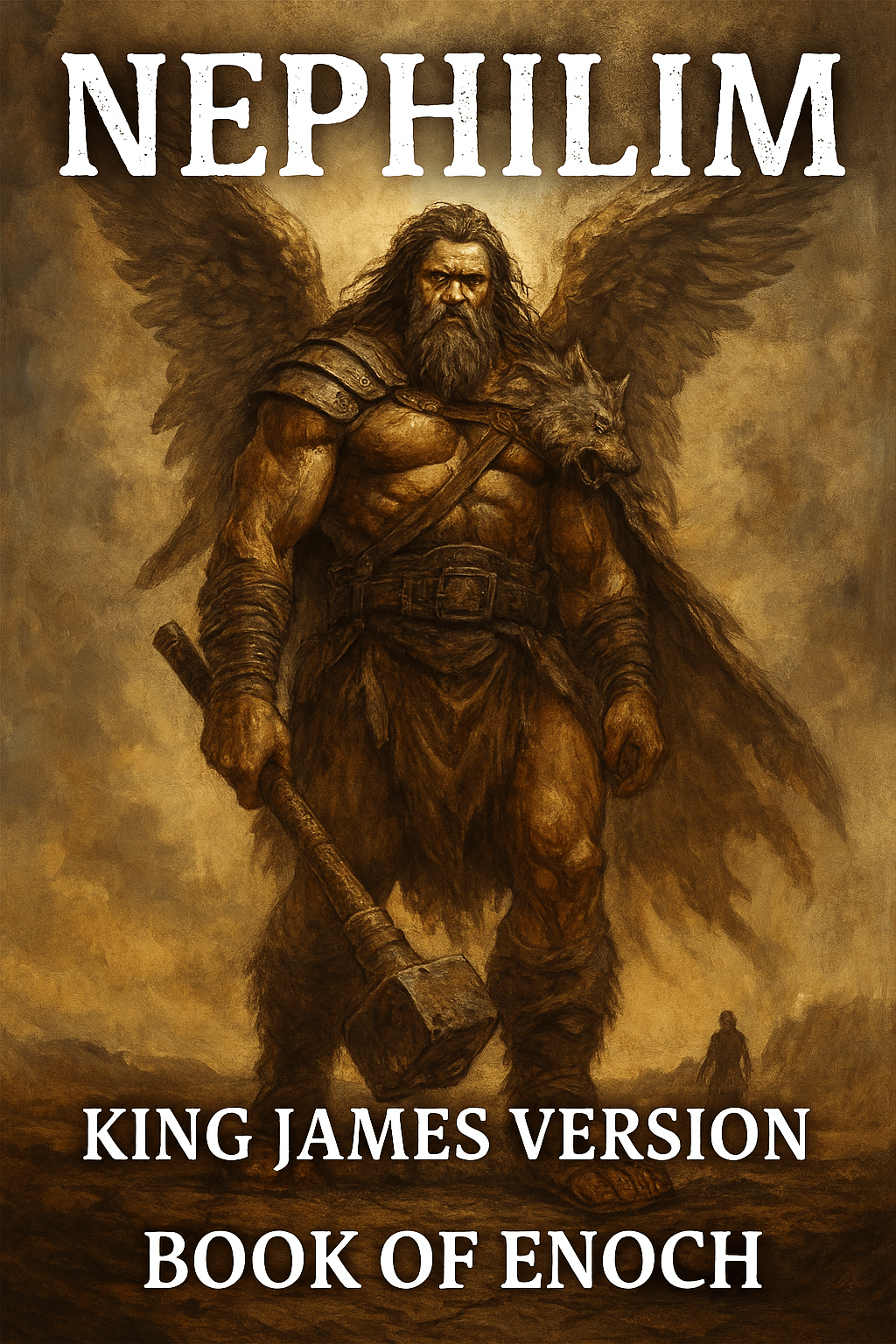
I tend to get distracted by a topic and then dive deeply into it because my mind will keep going down the rabbit hole until I am exhausted. so here is an excerpt of the things I have learned the last few weeks.
The King James Version (KJV) gives a brief, mysterious account of the Nephilim as “giants” born from the union of the “sons of God” and “daughters of men” (Genesis 6:1–4). The Book of Enoch, however, expands this into a vivid narrative: fallen angels called Watchers descend, take human wives, and produce the Nephilim—violent giants whose corruption leads to the Flood.
King James Version (KJV)
- Genesis 6:1–4:
- “Sons of God” saw the “daughters of men” and took them as wives.
- Their offspring were “giants” (Nephilim), described as “mighty men… men of renown.”
- Numbers 13:33: Later Israelites report seeing “giants, the sons of Anak,” linking them to the Nephilim.
- Tone & Detail:
- Very brief and ambiguous.
- No names of angels, no explanation of their sin, and no elaboration on the giants’ behavior.
- Leaves room for interpretation: are “sons of God” angels, divine beings, or simply human rulers?
Nephilim in the Book of Enoch
- 1 Enoch 6–8:
- A group of angels called Watchers descend to earth.
- They lust after human women, take them as wives, and father the Nephilim.
- These giants are described as enormous, violent, and corrupt, consuming humans and spreading bloodshed.
- Names & Details:
- Specific leaders of the Watchers are named (e.g., Semjaza, Azazel).
- Angels also teach forbidden knowledge (sorcery, weapon-making, astrology).
- Moral Framework:
- The Nephilim’s corruption is a direct cause of the Flood.
- God sends archangels (Michael, Gabriel, Raphael, Uriel) to punish the Watchers and destroy the Nephilim.
- Tone & Detail:
- Highly mythological and apocalyptic.
- Provides a cosmic backstory to human wickedness before Noah.
Key Comparisons
| Aspect | KJV (Genesis, Numbers) | Book of Enoch |
|---|---|---|
| Length | Brief (few verses) | Extensive (chapters) |
| Identity of “sons of God” | Ambiguous | Explicitly fallen angels (Watchers) |
| Nephilim description | Giants, “mighty men of renown” | Gigantic, violent, cannibalistic beings |
| Cause of Flood | Human wickedness broadly | Direct corruption by Nephilim and Watchers |
| Names/details | None | Many angelic names, detailed sins |
| Canon status | Canonical in Bible | Non-canonical (except Ethiopian Orthodox) |
Contrast in Purpose
- KJV: Presents the Nephilim as a mysterious backdrop to human wickedness before the Flood.
- Book of Enoch: Offers a theological explanation—fallen angels corrupted creation, necessitating divine judgment.
In short: The KJV leaves the Nephilim as enigmatic “giants,” while the Book of Enoch transforms them into a central drama of angelic rebellion, forbidden knowledge, and divine punishment.
Early Jewish & Christian Interpretations
- Jewish tradition:
- Rabbinic writings often debated whether “sons of God” were angels or human rulers.
- Some leaned toward a more human interpretation to avoid angelic scandal.
- Early Christians:
- Writers like Justin Martyr and Irenaeus accepted the Book of Enoch’s angelic reading, seeing the Watchers as proof of demonic corruption.
- Tertullian even argued Enoch should be considered Scripture because it explained Genesis.
- Others, like Augustine, rejected the angelic view, preferring to see “sons of God” as descendants of Seth (the godly line) mixing with Cain’s line.
Medieval & Renaissance Thought
- Augustine’s influence: His “Sethite” interpretation dominated Western Christianity for centuries, minimizing the angelic rebellion.
- Mystical traditions: Kabbalistic and esoteric writings sometimes revived the Enochian version, linking Nephilim to cosmic mysteries and fallen angels.
- Art & literature: Medieval art rarely depicted Nephilim directly, but Renaissance thinkers rediscovered Enoch and began speculating again about angelic unions.
Reformation & Modern Christianity
- Protestant Reformers: Generally stuck with the canonical KJV account, treating Enoch as apocryphal.
- Modern Evangelicals: Some embrace the Enochian narrative, especially in apocalyptic or “end times” theology, seeing parallels between ancient angelic corruption and modern demonic activity.
- Mainline traditions: Often prefer the symbolic Sethite reading, focusing on human sin rather than angelic rebellion.
Cultural Legacy
- Literature & film:
- The Enochian version inspired fantasy and horror genres (fallen angels, giants, forbidden knowledge).
- The KJV’s vagueness gave rise to mystery and speculation, fueling conspiracy theories and popular culture (e.g., Nephilim as aliens).
- Theological debates:
- The contrast between the sparse KJV and the elaborate Enoch shows how interpretive gaps in Scripture invite myth-making.
- Enoch’s vivid narrative gave later writers a ready-made mythos, while the KJV kept things enigmatic.
Big Picture:
- The KJV Nephilim are mysterious giants, leaving interpretation open.
- The Enoch Nephilim are part of a cosmic drama of angelic rebellion, corruption, and divine judgment.
- Later traditions oscillated between these: Augustine’s human-focused Sethite reading vs. apocalyptic writers who embraced Enoch’s angelic rebellion.
Disclaimer: Although, as most of you know I study the KJV as my go to Bible but use other bibles to aid in my full understanding-BUT I also will use books that are outside the Bible to gain other insight or historical context. I believe you have to be open minded to a point, without compromising understanding and belief of Biblical text. I have read many other non-biblical texts like Enoch, Thomas, and the complete Apocrypha.
Be sure to check out my books for further study.







 Grow Stronger Roots