I never expected the twelve disciples to impact my life the way they have. For years, they were just names on a page — familiar, but distant. But when I began to look closely at who they were, something in me changed. These weren’t flawless spiritual giants. They were ordinary men with ordinary struggles, yet Jesus called them anyway.
When I read how Jesus walked by the Sea of Galilee and said to Peter and Andrew, “Follow me, and I will make you fishers of men” (Matthew 4:19 KJV), it struck me that He didn’t choose them because they were already qualified. He chose them because He saw what they could become. That truth began to soften the pressure I’d always felt to “have it all together.”
Peter’s boldness, Matthew’s past as a tax collector, Thomas’s doubts — none of it pushed Jesus away. Matthew himself records Jesus calling him while he was still sitting at the receipt of custom (Matthew 9:9 KJV). That moment reminds me that Christ meets us where we are, not where we think we should be.
Even the presence of Simon the Zealot amazes me. A man once driven by political passion now walking alongside Matthew, who had worked for Rome. Only Jesus could unite people like that. It echoes His prayer for His followers: “that they all may be one” (John 17:21 KJV). Their unity wasn’t built on sameness — it was built on surrender.
Seeing their diversity has helped me embrace my own background. For a long time, I felt like my past disqualified me. But the disciples remind me that Jesus doesn’t erase our stories; He redeems them. Paul later wrote, “God hath chosen the foolish things of the world to confound the wise” (1 Corinthians 1:27 KJV), and I see that truth reflected in the disciples’ lives — and in mine.
Their failures also give me hope. Peter sinking in the water (Matthew 14:30 KJV), Thomas needing to see the wounds (John 20:25 KJV), the disciples arguing about who was greatest (Luke 22:24 KJV) — they were learning, stumbling, growing. And Jesus never gave up on them. That has helped me trust that He won’t give up on me either.
What impacts me most is how their differences became strengths once they surrendered to Christ. Fishermen who knew teamwork. A tax collector who understood details. A zealot whose passion was redirected. It reminds me of Paul’s words: “For the body is not one member, but many” (1 Corinthians 12:14 KJV). God uses our differences to build something bigger than any of us could build alone.
The disciples’ story has reshaped how I see myself, how I see others, and how I see the calling of Christ. Their lives remind me that following Jesus isn’t about perfection — it’s about willingness. It’s about hearing His voice, just as they did, and choosing to rise, leave our nets behind, and walk with Him (Matthew 4:20 KJV).
When we picture the twelve disciples, it’s easy to imagine a tight‑knit group who always understood one another and naturally worked together. But the truth is far more compelling. These men came from different walks of life, carried different personalities, and represented different social classes—yet they were drawn into a single movement that would reshape history.
Their unity wasn’t the product of similarity. It was the result of Christ’s call.
A Mosaic of Backgrounds
The disciples weren’t chosen from the religious elite or the political ruling class. They were ordinary people with ordinary jobs—yet each brought something unique to the table.
Fishermen like Peter, Andrew, James, and John were hardworking, practical, and accustomed to long nights and unpredictable waters. Their resilience became a backbone of the early church.
A tax collector like Matthew came from a profession despised by his own people. His inclusion showed that no one was beyond redemption or purpose.
A zealot like Simon belonged to a radical political movement. His fiery passion was redirected from rebellion to the gospel.
A skeptic like Thomas brought a thoughtful, questioning mind that helped strengthen the faith of others.
A treasurer like Judas—though his story ends tragically—reminds us that even those close to Jesus wrestled with human weakness.
This wasn’t a group that would naturally gather around a table. Yet Jesus brought them together intentionally.
What United Them
1. A Shared Calling
Each disciple heard the same invitation: “Follow me.” That simple call cut across their differences. Christ didn’t ask them to become identical—He asked them to walk with Him.
2. A Shared Transformation
They didn’t start as spiritual giants. They argued, misunderstood, doubted, and failed. But walking with Jesus reshaped them. Their unity grew not from perfection but from shared transformation.
3. A Shared Mission
After the resurrection, these once‑ordinary men carried the gospel across continents. Their backgrounds became assets:
Fishermen knew how to work in teams.
A tax collector understood record‑keeping and organization.
A zealot knew how to speak to the passionate and politically driven.
A skeptic knew how to reach those who needed evidence.
Their diversity didn’t hinder the mission—it amplified it.
Why Their Story Still Matters
The disciples remind us that the kingdom of God is built not on sameness but on surrender. Christ doesn’t erase our backgrounds; He redeems them. He doesn’t flatten our personalities; He channels them.
In a world fractured by differences, the disciples show what’s possible when people unite around a purpose greater than themselves.
They were fishermen and tax collectors, skeptics and zealots—yet together, they became the foundation of the church.
And their story invites us to consider: What could Christ do with our differences if we offered them to Him?
Over the past five decades (roughly 1975 to 2025), church attendance in the United States has undergone a profound transformation. What was once a cornerstone of American social life—attending religious services weekly or nearly weekly—has seen a steady decline, particularly from the 1990s onward. Yet, recent data suggests this downward trend may be slowing or even stabilizing, with hints of resurgence among younger generations.
The Peak and Early Decline (1970s–1990s)
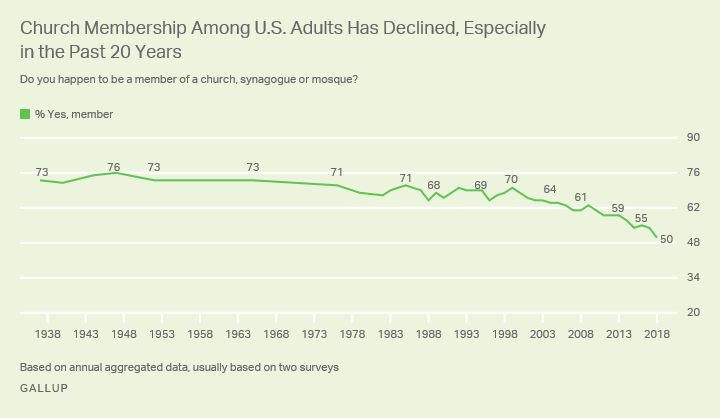
In the mid-20th century, church attendance was at historic highs. Gallup data from the 1950s showed weekly attendance rates around 49%, with church membership hovering near 70–76%. By the 1970s and 1980s, membership remained relatively stable at about 68–70%, but subtle shifts were underway. Cultural changes, including greater mobility, secular education, and evolving social norms, began eroding regular participation.
U.S. Church Membership Down Sharply in Past Two Decades
This Gallup chart illustrates the sharp drop in U.S. church membership over recent decades, closely mirroring attendance trends.
Acceleration of Decline (2000s–2010s)
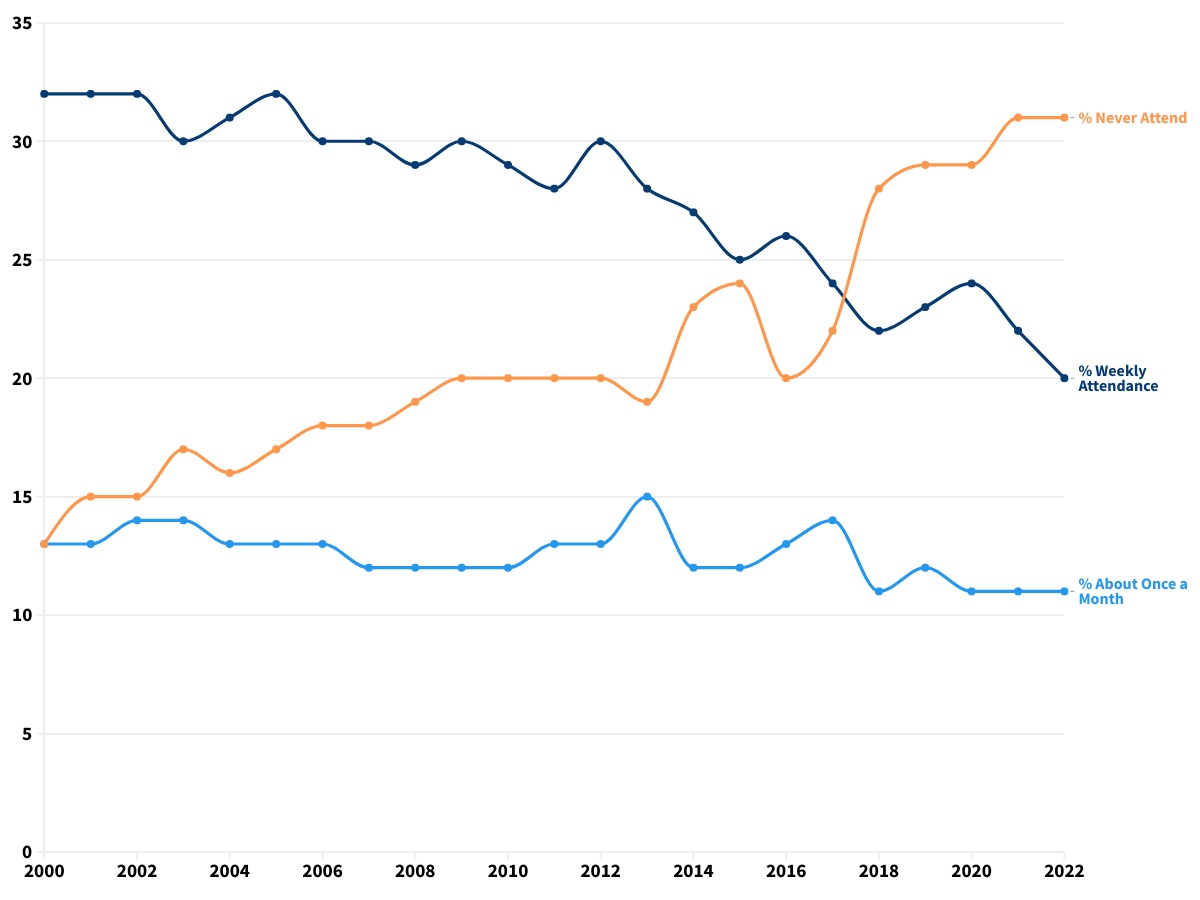
The most dramatic declines occurred in the 21st century. Gallup reports that weekly or nearly weekly attendance fell from about 42% around 2000 to 30% by the early 2020s. Church membership dropped below 50% for the first time in 2020, down from 70% in 1999. Pew Research Center data echoes this, showing monthly attendance declining from 54% in 2007 to around 45% by 2018–2019.
Factors contributing to this include:
Rise of the religiously unaffiliated (“nones”), growing from under 10% in the 1990s to over 28% today.
Generational shifts, with younger adults less likely to attend.
Scandals in religious institutions and polarization tying religion to politics.
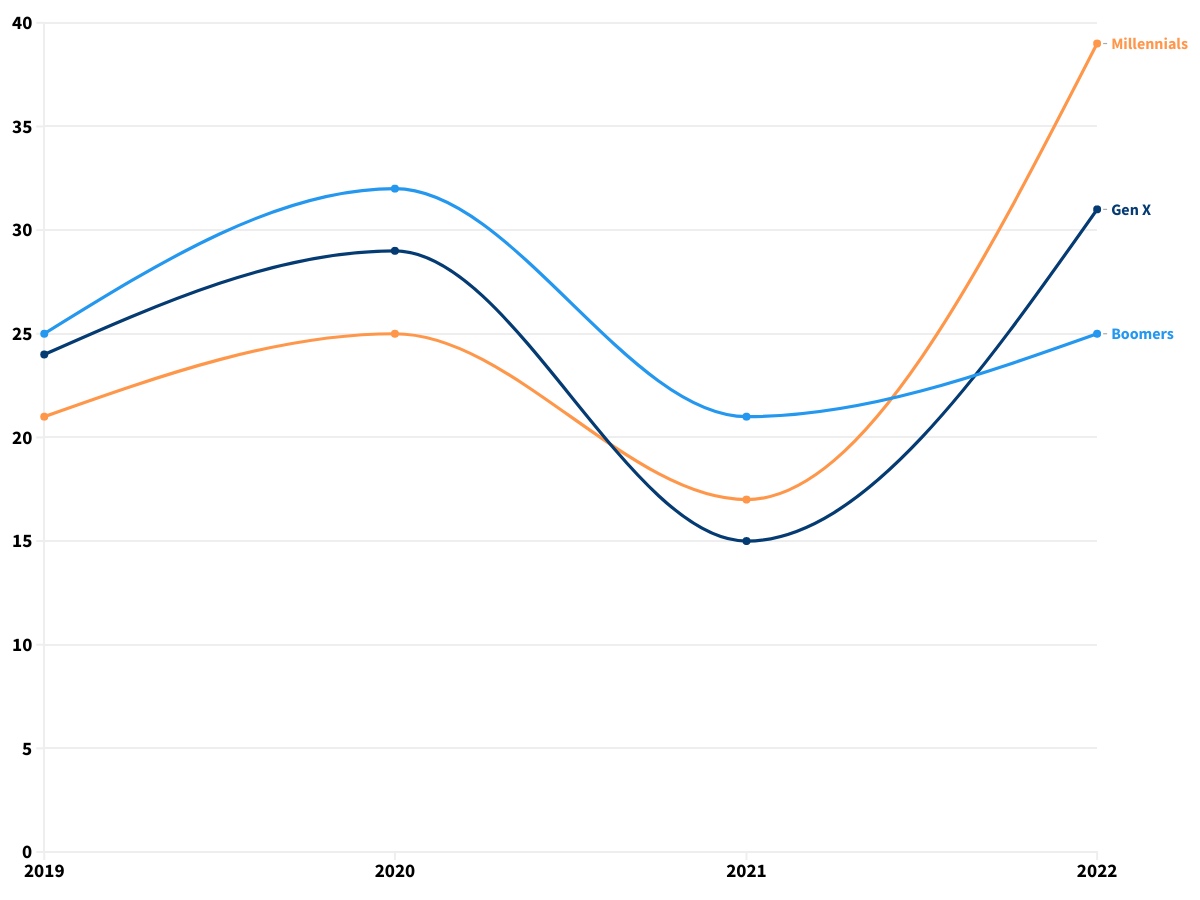
These charts highlight the steady decline in regular attendance and shifts among specific groups like Millennials.
The COVID Era and Recent Signs of Stability (2020–2025)
The COVID-19 pandemic accelerated the drop temporarily, with in-person attendance plummeting. Post-pandemic recovery has been partial—many churches report being at 85% of pre-2020 levels. However, encouraging signs have emerged since around 2020:
Pew’s 2023–2024 Religious Landscape Study indicates the long-term decline in Christian identification has slowed or leveled off at about 62%.
Barna and other reports note rising attendance among Millennials and Gen Z, with weekly rates for Millennials increasing from 21% in 2019 to 39% in some surveys.
Among Gen Z, church membership reportedly rose from 45% to 51% between 2023 and 2024.
Non-denominational and charismatic churches have seen growth, offsetting losses in mainline denominations.
A Global Perspective
While U.S. trends show decline followed by stabilization, global patterns vary. Christianity is growing rapidly in Africa and Latin America through conversions and high birth rates. In Western Europe, attendance has fallen to single digits in many countries over decades. The U.S. remains more religious than most developed nations but follows similar secularization patterns.
What Does the Future Hold?
The past five decades reveal a clear story of decline driven by cultural secularization, but the last few years offer cautious optimism. Younger generations’ renewed interest—possibly spurred by a search for meaning amid isolation and uncertainty—could signal a turning point. Churches adapting with hybrid services, community outreach, and relevant engagement may thrive.
The Future of the Church: A Call to Faithful Obedience
The outlook for the Christian church in America—and indeed worldwide—grows increasingly uncertain without a renewed commitment from believers to step up and fulfill the clear commands Jesus gave us in the Gospels of Matthew and Mark. As Jesus prepared to ascend to heaven, He issued what we know as the Great Commission: “Go therefore and make disciples of all nations, baptizing them in the name of the Father and of the Son and of the Holy Spirit, teaching them to observe all that I have commanded you” (Matthew 28:19-20). In Mark’s account, He declared, “Go into all the world and proclaim the gospel to the whole creation” (Mark 16:15). These aren’t optional suggestions—they’re marching orders for every follower of Christ.
If more Christians don’t take ownership of this mission—actively sharing the gospel, discipling others, and living out our faith boldly—the church’s vitality will continue to wane. We’ve already seen decades of decline in attendance and cultural influence, with empty pews becoming a stark symbol in many congregations.
Yet, this isn’t about chasing massive crowds or building empires. Personally, I’m skeptical of the megachurch model—those sprawling congregations with thousands in attendance, often driven by entertainment, celebrity pastors, and transfer growth from other churches. While some megachurches do faithful work, many prioritize size and spectacle over depth, and recent trends show their explosive growth from decades past has slowed. Instead, I firmly believe that every community needs a solid, Bible-believing and Bible-preaching church—a local body of believers committed to sound doctrine, heartfelt worship, and genuine fellowship.
Local churches are the frontline of God’s kingdom work. They’re where the gospel is proclaimed week after week, where believers are equipped through faithful preaching, and where authentic relationships foster accountability and growth. It’s in these settings that Christians can most effectively live out the Great Commission—sharing the good news in everyday conversations, serving their communities, and making disciples who make disciples.
Recent data offers a mix of caution and hope. While overall church attendance has declined over the past five decades, with many congregations still recovering from pandemic lows, there’s evidence of stabilization—and even resurgence among younger generations like Millennials and Gen Z. Barna reports rising attendance among these groups, with some surveys showing weekly participation nearly doubling in recent years. This could signal a turning point if believers seize the moment.
But stabilization alone isn’t enough. The church’s future isn’t dismal by default—it’s contingent on our obedience. If we return to the basics: preaching the full counsel of God’s Word, prioritizing local community impact over flashy programs, and empowering every believer to evangelize, we can see renewal. Every neighborhood deserves a lighthouse—a Bible-centered church where truth is taught unapologetically, lives are transformed, and the gospel goes forth.
Yet challenges remain: fewer Americans see religion as “very important,” and “nones” continue to grow in some metrics. Whether this stabilization endures will depend on how religious communities respond to a changing society.
Data from Gallup, Pew Research Center, Barna, and Lifeway Research provide the foundation for these insights, reflecting a complex but evolving religious landscape in America.
As I sit here this Christmas season, reflecting on the lights twinkling on the tree and the carols filling the air, my heart turns once again to the profound truth at the center of it all: the birth of our Lord Jesus Christ. This holy day is not merely a time for gifts and gatherings, but a celebration of God’s perfect will unfolding in the most humble and glorious way.
In the fullness of time, God sent forth His Son, born of a woman, to redeem us who were under the law. The angels proclaimed it clearly that holy night: “Glory to God in the highest, and on earth peace, good will toward men” (Luke 2:14, KJV). What is this “good will toward men”? It is nothing less than the gracious will of God to extend mercy and salvation to a fallen world.
Long before that starry night in Bethlehem, the prophet Isaiah foretold: “For unto us a child is born, unto us a son is given: and the government shall be upon his shoulder: and his name shall be called Wonderful, Counsellor, The mighty God, The everlasting Father, The Prince of Peace” (Isaiah 9:6, KJV). This was no accident or afterthought—it was the eternal will of God, planned before the foundation of the world, to provide a Saviour.
Even our Lord Jesus Himself embodied perfect submission to this will. Though He was equal with God, He came not to do His own will, but the will of the Father who sent Him. As He later prayed in the garden, “not my will, but thine, be done” (Luke 22:42, KJV). His entire life, beginning in that manger, was dedicated to fulfilling the Father’s purpose: “My meat is to do the will of him that sent me, and to finish his work” (John 4:34, KJV).
And what is that glorious will? The Scriptures declare it plainly: God is “not willing that any should perish, but that all should come to repentance” (2 Peter 3:9, KJV). His will is our salvation through faith in Christ. “Who will have all men to be saved, and to come unto the knowledge of the truth” (1 Timothy 2:4, KJV). The babe in the manger grew to be the Lamb of God, who taketh away the sin of the world, that whosoever believeth in Him should not perish, but have everlasting life (John 3:16).
This Christmas, amid the joy and festivities, I am reminded that the greatest gift is not under the tree, but the One who hung upon it for my sins. As we celebrate His coming, let us also yield our lives to His will, for “the world passeth away, and the lust thereof: but he that doeth the will of God abideth for ever” (1 John 2:17, KJV).
May the peace of God, which passeth all understanding, fill your heart this Christmas as you ponder His perfect will revealed in Jesus Christ, our Lord.
Merry Christmas and may God Bless you greatly this coming year as you grow in Faith and understanding of His Word!
As I ponder the times in which we live, I find myself grieved by how far the world has strayed from the clear teaching of God’s Word on matters of gender and human sexuality. In this age, many declare that a person may define their own identity, that gender is fluid, and that any form of sexual expression is acceptable so long as it feels right to the individual. Yet, as a follower of the Lord Jesus Christ, I must stand upon the unchanging truth of Scripture, even when it brings reproach.
Let us begin at the beginning, as the Lord Himself did. In Genesis 1:27, the Holy Ghost declares: “So God created man in his own image, in the image of God created he him; male and female created he them.” Here is God’s perfect design—male and female, distinct yet equal, both bearing His image. This is no accident or cultural construct, but the very foundation of humanity.
When the Pharisees questioned our Savior about marriage, He pointed them back to this truth. In Matthew 19:4-5, Jesus saith: “Have ye not read, that he which made them at the beginning made them male and female, And said, For this cause shall a man leave father and mother, and shall cleave to his wife: and they twain shall be one flesh?” The Lord affirms that marriage—and indeed, human sexuality—is ordained between one man and one woman, becoming one flesh in God’s sight.
The Apostle Paul, under inspiration, further warns of the consequences when mankind rejects this design. In Romans 1:26-27: “For this cause God gave them up unto vile affections: for even their women did change the natural use into that which is against nature: And likewise also the men, leaving the natural use of the woman, burned in their lust one toward another; men with men working that which is unseemly, and receiving in themselves that recompence of their error which was meet.” Such practices are called unnatural, unseemly, and a recompence in themselves—a judgment from God upon those who suppress His truth.
Again, in 1 Corinthians 6:9-11: “Know ye not that the unrighteous shall not inherit the kingdom of God? Be not deceived: neither fornicators, nor idolaters, nor adulterers, nor effeminate, nor abusers of themselves with mankind… And such were some of you: but ye are washed, but ye are sanctified, but ye are justified in the name of the Lord Jesus, and by the Spirit of our God.” These sins, including homosexual acts, bar one from the kingdom unless repented of. Yet praise God—there is hope! Some in the Corinthian church had been delivered from these very things through the washing and sanctifying power of Christ.
I do not write these words with hatred in my heart, for the Lord commands us to love our neighbor. Many today wrestle with confusion, pain, or strong temptations in these areas, and my soul aches for them. But love does not affirm what God calls sin; true love points to the Savior who can redeem and transform. As Ephesians 4:15 instructs: “But speaking the truth in love, may grow up into him in all things, which is the head, even Christ.”
Dear reader, if you are struggling, know that Christ Jesus came into the world to save sinners. Repent, believe the Gospel, and find freedom in surrendering to God’s good design. For the church, let us hold fast the faithful word, extend compassion without compromise, and pray for revival.
Imagine a crowded city square in the near future. A towering statue—sleek, metallic, and lifelike—suddenly stirs. Its eyes flicker with artificial light, and a synthetic voice echoes across the plaza: “Bow before me.” The crowd gasps as the machine speaks, commanding loyalty not just with words but with the threat of exclusion, punishment, even death.
It sounds like science fiction, but this scene mirrors one of the most chilling passages in the Bible: Revelation 13:15, where the “image of the beast” is given breath, speaks, and enforces worship.
The Biblical Text
Revelation 13:15: “The second beast was permitted to give breath to the image of the first beast, so that the image could speak and cause all who refused to worship it to be killed.”
The “image” is lifeless until animated, then suddenly it speaks and wields authority.
Traditional Interpretations
Idolatry: The image as a symbol of false worship, echoing Old Testament warnings against carved idols.
Political Propaganda: A metaphor for state power or religious institutions demanding allegiance.
Spiritual Deception: The “breath” represents demonic influence animating systems of control.
Modern Technological Lens
With the rise of AI and robotics, the passage feels eerily relevant:
Artificial Life: Machines today mimic human behavior, speech, and creativity. “Breathing life” into an image parallels how AI animates lifeless hardware.
Speech & Influence: Revelation’s image speaks with authority. AI chatbots, humanoid robots, and virtual assistants already influence millions daily.
Control & Enforcement: The text warns of coercion tied to the image. In our world, AI-driven surveillance and digital systems increasingly regulate access to commerce and society.
Why This Matters
Cultural Relevance: Each generation interprets Revelation through its own lens. Medieval readers thought of idols; 20th-century interpreters saw television; today, AI feels like the natural candidate.
Ethical Questions: If technology can enforce conformity, where does human freedom fit?
Spiritual Reflection: Whether literal or symbolic, the passage challenges us to discern what powers we worship—political, technological, or spiritual.
Conclusion
Revelation 13’s “image of the beast” remains one of the most mysterious symbols in Scripture. While traditional interpretations emphasize idolatry and deception, modern readers can’t help but see echoes of robots and AI in its description of a lifeless statue suddenly speaking and demanding allegiance. Whether prophecy or metaphor, the passage invites us to reflect on how technology shapes our worship, loyalty, and freedom.
As we find ourselves surrounded by the beauty and joy of the Christmas season, my heart is drawn back to the true reason we celebrate. Beyond the lights, the music, and the gatherings, Christmas is a reminder of God’s incredible love — a love so great that He sent His Son into the world to bring us hope, peace, and salvation.
I want to take this moment to wish each of you a very Merry Christmas. May the Lord bless you richly, not only with the desires of your heart this season, but with the deeper joy that comes from knowing Him. For while we cherish the gifts exchanged among family and friends, we must never forget that God has already given us the greatest gift of all: eternal salvation through His grace.
So as you celebrate, may your homes be filled with laughter, your hearts with gratitude, and your lives with the light of Christ. Let us rejoice together, for unto us a Savior is born — the gift that never fades, the promise that never fails.
Throughout the New Testament, Jesus repeatedly declares “I have come” (or “I came”) to reveal His mission. Each statement is a window into His purpose, and together they form a powerful portrait of why He entered the world. Let’s explore these verses directly from the King James Version (KJV).
Fulfillment of the Law
“Think not that I am come to destroy the law, or the prophets: I am not come to destroy, but to fulfil.” — Matthew 5:17 (KJV)
Jesus affirms that His coming is not to abolish God’s Word, but to bring it to completion.
Division and Decision
“Think not that I am come to send peace on earth: I came not to send peace, but a sword.” — Matthew 10:34 (KJV)
“Suppose ye that I am come to give peace on earth? I tell you, Nay; but rather division.” — Luke 12:51 (KJV)
His presence forces a choice. Following Him is not neutral—it divides truth from falsehood.
Service and Sacrifice
“Even as the Son of man came not to be ministered unto, but to minister, and to give his life a ransom for many.” — Matthew 20:28 (KJV)
“I came not to call the righteous, but sinners to repentance.” — Mark 2:17 (KJV)
Jesus defines His mission in humility: serving others and offering His life for salvation.
Sent from Heaven
“For I came down from heaven, not to do mine own will, but the will of him that sent me.” — John 6:38 (KJV)
“I am come a light into the world, that whosoever believeth on me should not abide in darkness.” — John 12:46 (KJV)
His origin is divine. He comes from heaven to reveal God’s will and bring light into darkness.
Abundant Life
“I am come that they might have life, and that they might have it more abundantly.” — John 10:10 (KJV)
This is the heartbeat of His mission: not mere existence, but fullness of life in Him.
Conclusion
The repeated phrase “I have come” in the KJV is more than a statement—it is a declaration of purpose. Jesus came to fulfil prophecy, call sinners, serve humbly, bring division where truth demands it, shine light in darkness, and give abundant life. Each verse is a glimpse into His mission, and together they invite us to embrace the fullness of His work.
I just heard this song for the first time on the radio this morning and it really got me to think……..What God Wants for Christmas by Darius Rucker.
As I listened to Darius Rucker’s song “What God Wants for Christmas,” I found myself pausing in the middle of the holiday rush. The lyrics remind me that Christmas isn’t about the gifts under the tree or the lights strung across the house—it’s about something far deeper. Rucker sings of wondering what God Himself might want for Christmas, and that question struck me right in the heart.
When I think about it, the answer is already written in Scripture. God doesn’t desire the material things we so often chase. Instead, He longs for our hearts, our faith, and our love.
“For where your treasure is, there will your heart be also.” (Matthew 6:21, KJV)
This verse reminds me that the true treasure of Christmas isn’t wrapped in shiny paper—it’s found in giving God our devotion. Rucker’s song imagines peace on Earth and full churches as part of God’s “wishlist.” That aligns perfectly with the angels’ proclamation at Christ’s birth:
“Glory to God in the highest, and on earth peace, good will toward men.” (Luke 2:14, KJV)
Peace and goodwill—those are gifts we can actually give. They don’t cost a dime, but they require humility, forgiveness, and love. And isn’t that what Christ came to teach us?
The song also asks, “What do you give someone who gave His only Son?” That line echoes one of the most famous verses in the Bible:
“For God so loved the world, that he gave his only begotten Son, that whosoever believeth in him should not perish, but have everlasting life.” (John 3:16, KJV)
What God wants for Christmas is simple yet profound: our belief in Him, our trust in His Son, and our willingness to live out that faith in love toward others. No store can sell it, no credit card can buy it. It’s a gift only we can give.
So this Christmas, as I hum along to Darius Rucker’s heartfelt song, I’m reminded to step back from the chaos of shopping lists and holiday parties. I want to give God what He truly desires—my heart, my faith, and my love lived out in action. That’s the kind of gift that lasts far beyond December 25th.
What God Wants for Christmas by Darius Rucker
old man playin’ santa clause blew into town with old jack frost now he’s handing out candy canes and smiles for free people scurry with their list rushing around to buy those gifts that will end up wrapped up underneath that tree i’m sitting at this red light looking at a manger scene watching snowflakes kiss that baby and it makes me think i wonder what God wants for christmas something that you can’t find in a store maybe peace on earth no more empy seats in church might be what’s on his wish list i wonder what God wants for christmas
what do you give someone who gave his only son what if we believed in him like he believes in us i wonder what God wants for christmas what might put a smile on his face every bible with no dust the devil giving up would be what’s on his wish list yeahhh… i wonder what God wants for christmas what kind of gift from you and me more sister more brother more love in one another yeah, i wonder i wonder what God wants by know we oughta know what God wants for christmas
As we approach Christmas on this December day in 2025, the season of Advent invites us to pause amid the hustle and embrace a deeper hope. In a world that often feels chaotic and uncertain, Advent reminds us that God entered our story not with fanfare, but with quiet promise—the promise of light breaking into darkness.
Advent spans four weeks, each traditionally marked by lighting a candle on the wreath: Hope, Peace, Joy, and Love. These aren’t just decorations—they’re declarations. The first candle, for hope, echoes the prophets who foretold a Messiah. In Isaiah 9:2, we read: “The people walking in darkness have seen a great light; on those living in the land of deep darkness a light has dawned.”
This hope isn’t fleeting; it’s anchored in God’s faithfulness. Even when life feels like prolonged waiting—through personal trials, global unrest, or quiet seasons of doubt—Advent teaches us to anticipate God’s intervention.
The Star That Guided
Remember the wise men following the star? That celestial sign led them to the humble birthplace of the King.
In Matthew 2:2, they asked, “Where is the one who has been born king of the Jews? We saw his star when it rose and have come to worship him.” Today, we might not see a literal star, but God still guides us through His Word, prayer, and the Holy Spirit. What “stars” is He placing in your life this season to draw you closer to Him?
The Humble Arrival
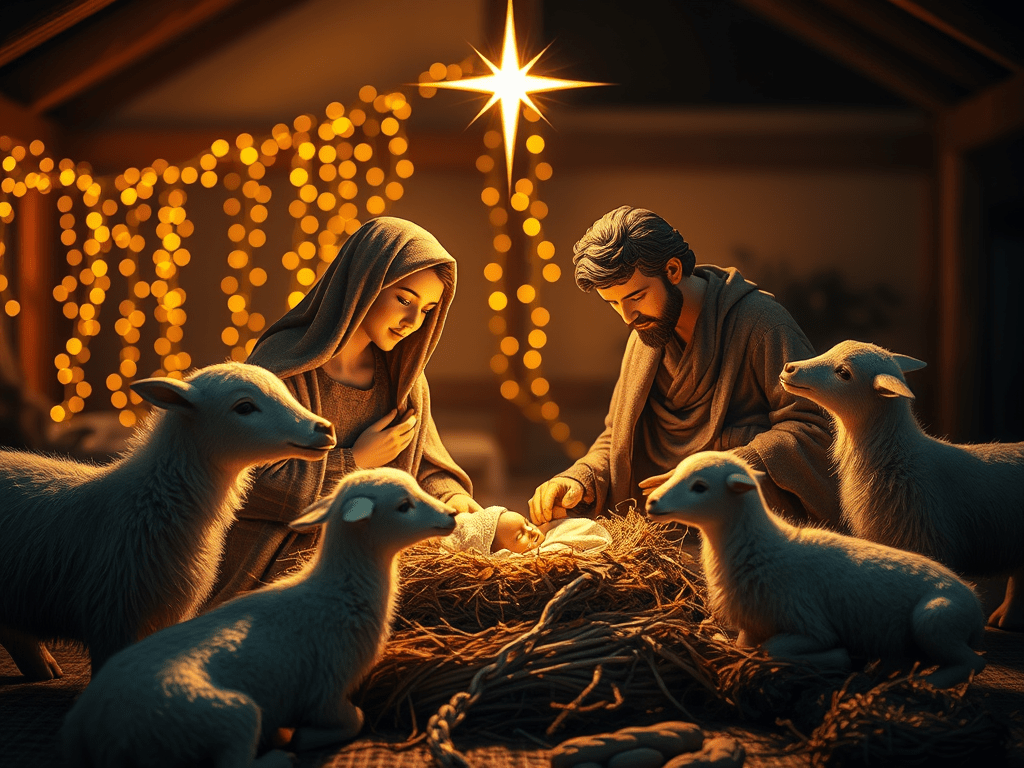
At the heart of Christmas is the Nativity: God becoming flesh in a manger.
Luke 2:7 tells us, “And she gave birth to her firstborn, a son. She wrapped him in cloths and placed him in a manger, because there was no guest room available for them.” The King of Kings entered not in power, but in vulnerability. This challenges us: In our pursuit of comfort and success, are we making room for Jesus?
A Call to Reflection and Action
This Advent, let’s linger in hope. Read the prophecies in Isaiah, reflect on the angels’ announcement to the shepherds, and prepare your heart for renewed joy. Share this light with others—through acts of kindness, forgiveness, or simply listening.
As John 1:5 declares: “The light shines in the darkness, and the darkness has not overcome it.”
May this Christmas fill you with the unshakable hope of Emmanuel—God with us.
Prayer: Heavenly Father, in this Advent season, renew our hope in Your promises. Help us see Your light in the darkness and share it boldly. In Jesus’ name, Amen.










 Grow Stronger Roots