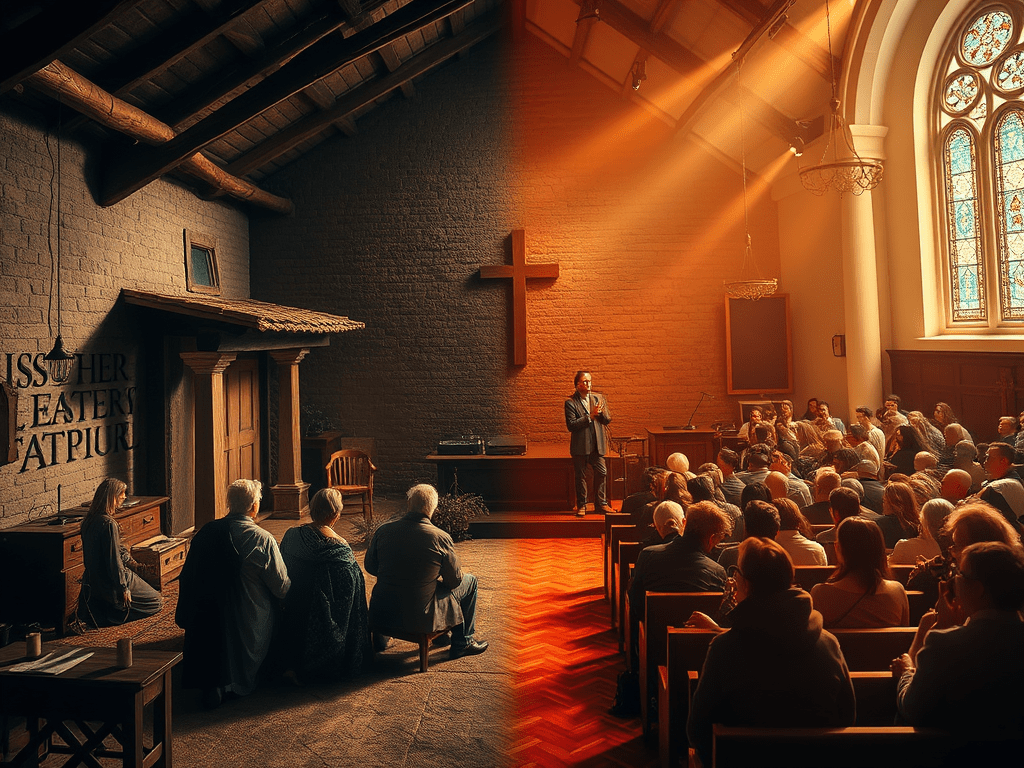
Hearing the Echoes of the Early Church
Step into almost any church today—pews or theater seats, pipe organ or praise band—and it can feel a world away from the dusty streets and house gatherings of the first century. Yet behind the microphones, projectors, and programs, Christians still confess the same crucified and risen Christ preached by the apostles. This tension raises an honest question: how is the church really different now than it was in biblical times, and how is it recognizably the same?
Looking at Scripture (quoted here from the KJV) alongside basic historical developments, we can trace both continuity and change. The goal is not nostalgia for a “golden age,” but clarity: to see where we’ve drifted in form, where we’ve grown, and where we must cling tightly to what the New Testament calls “the faith which was once delivered unto the saints” (Jude 1:3, KJV).
1. Foundations: Same Gospel, Different World
The New Testament church was born into a first‑century Jewish and Greco‑Roman world, without church buildings, legal recognition, or centuries of tradition. They were a small, often persecuted minority on the margins of empire. Today, many churches operate in societies where Christianity has centuries of history, legal protection, and deep cultural influence—or else in post‑Christian or hostile environments that present very different pressures.
The message itself, however, is recognizable. Paul declares, “For I delivered unto you first of all that which I also received, how that Christ died for our sins according to the scriptures; And that he was buried, and that he rose again the third day” (1 Corinthians 15:3–4, KJV). The early church preached repentance and faith in Jesus as Lord and Savior; biblically faithful churches still center on this same gospel.
2. Gatherings and Structure
Early church pattern
In the New Testament, believers usually met in homes or informal spaces. Paul greets “the church that is in their house” (Romans 16:5, KJV; see also Colossians 4:15; Philemon 1:2), suggesting small, relational congregations. Leadership was simple and local: elders (also called bishops/overseers) and deacons serving among the people (Philippians 1:1, KJV).
Paul and his coworkers “ordained them elders in every church” (Acts 14:23, KJV), and Titus was instructed to “ordain elders in every city” (Titus 1:5, KJV). There were no denominational headquarters or complex boards—just interconnected congregations held together by apostolic teaching, shared faith, and mutual care.
In the first few centuries, this house‑church model continued, even under sporadic persecution. Only after Christianity was tolerated and then favored by the Roman Empire did large basilica‑style buildings, vested clergy, and regional hierarchies develop. Over time, roles like bishop, patriarch, and eventually pope emerged within this more institutional landscape.
Modern church pattern
Today, “church” can describe anything from a dozen believers in a living room to a multi‑campus congregation with thousands of members. Many churches own property, manage significant budgets, employ staff, and belong to formal denominations or networks. Leadership titles such as senior pastor, associate pastor, youth pastor, or worship pastor blend biblical roles (pastor/elder) with modern organizational needs.
New Testament gatherings often allowed active participation from ordinary members: “When ye come together, every one of you hath a psalm, hath a doctrine, hath a tongue, hath a revelation, hath an interpretation” (1 Corinthians 14:26, KJV). Today, services are usually more scripted—sermons, worship sets, and liturgies arranged in advance—with less spontaneous contribution in the main gathering, though many churches encourage mutual ministry in small groups or classes.
3. Worship: Simplicity and Sacraments vs Programs and Production
Early Christian worship
Acts presents a picture of focused yet simple worship: “And they continued stedfastly in the apostles’ doctrine and fellowship, and in breaking of bread, and in prayers” (Acts 2:42, KJV). Weekly gatherings involved teaching, prayer, singing, the Lord’s Supper, and collections for those in need (cf. Acts 20:7; 1 Corinthians 16:1–2, KJV).
The Lord’s Supper was central to their shared life; believers “brake bread from house to house” (Acts 2:46, KJV), treating this meal as a participation in Christ (1 Corinthians 10:16–17, KJV). Baptism marked conversion and entrance into the visible people of God: “Then they that gladly received his word were baptized: and the same day there were added unto them about three thousand souls” (Acts 2:41, KJV).
Historically, early Christians worshiped without organs, sound systems, or visual effects. Singing was congregational and unamplified. As centuries passed, liturgies developed—set prayers, Scripture readings, creeds, and fixed forms of the Eucharist—but the core still revolved around Word and table.
Contemporary worship
Modern churches may still read Scripture, preach, pray, baptize, and celebrate the Lord’s Supper, but the wrapping looks very different:
- Music might be organ‑accompanied hymns, choral anthems, or band‑driven worship with amplification, lights, and projected lyrics.
- Services are usually timed and programmatic.
- Some traditions place the sermon at the center; others place the Eucharist or liturgy at the heart.
Some congregations celebrate communion weekly, echoing the apparent pattern that “upon the first day of the week… the disciples came together to break bread” (Acts 20:7, KJV), while others do so monthly or less often. Baptism practices range from infant baptism, rooted in covenantal or sacramental theology, to believer’s baptism upon profession of faith.
These diverse patterns reflect centuries of theological debate and cultural influence—from the early councils, to medieval developments, to the Reformation and modern renewal movements.
4. Community Life and Ethics
Early church life
The New Testament church was marked by intense, sacrificial community. After Pentecost, believers in Jerusalem were “together, and had all things common; And sold their possessions and goods, and parted them to all men, as every man had need” (Acts 2:44–45, KJV; see also Acts 4:32–35). This was voluntary generosity, the overflow of love, not imposed by the state.
They understood themselves as a family in Christ. Paul calls them “the household of God” (Ephesians 2:19, KJV) and urges them to “Bear ye one another’s burdens” (Galatians 6:2, KJV). Church discipline also mattered; blatant, unrepentant sin was not ignored (1 Corinthians 5:1–5, KJV), because the purity and witness of the church were at stake.
Historically, early Christians became known for caring for widows, orphans, the sick, and the poor in societies that often neglected them. Their sexual ethics, commitment to life, and refusal to worship the emperor distinguished them sharply from surrounding culture and sometimes provoked persecution.
Modern community dynamics
Many churches today sincerely aim for this family‑like community through small groups, diaconal ministries, counseling, and benevolence. But modern realities—mobility, busy schedules, individualism, and digital relationships—often dilute the intensity of shared life. For many believers, “church” is something attended weekly rather than a people with whom they share daily rhythms.
Morally, Christians still look to passages like Romans 12–13, Galatians 5, and the Sermon on the Mount (Matthew 5–7, KJV) as their ethical north star. Yet the issues they navigate—technology, pluralism, media saturation, globalization—are very different from those faced in the first century. Applying “be not conformed to this world” (Romans 12:2, KJV) in a consumerist, entertainment‑driven culture requires fresh discernment rooted in ancient truth.
5. Authority, Tradition, and Diversity
Early scriptural and apostolic authority
The earliest churches lived under the direct teaching of the apostles and their close associates. “They continued stedfastly in the apostles’ doctrine” (Acts 2:42, KJV). Letters like Romans or 1 Corinthians were written to specific congregations, read aloud, and then shared more widely. At first, the New Testament canon was still being formed; believers relied on living apostolic witness and inspired letters as they circulated.
Paul urged Timothy, “Hold fast the form of sound words, which thou hast heard of me… That good thing which was committed unto thee keep” (2 Timothy 1:13–14, KJV). Early post‑apostolic writings show churches working to preserve this apostolic deposit against heresy and schism.
Development of traditions and denominations
Over the centuries, as the canon was recognized and copied, the church produced creeds (like the Nicene Creed) to summarize biblical teaching on the Trinity and the person of Christ. Later divisions in the West led to distinct Roman Catholic and Protestant streams, while Eastern Orthodoxy followed its own path. The Reformation further multiplied Protestant denominations over issues of authority (Scripture alone vs Scripture plus tradition), sacraments, church government, and more.
Today, the one body of Christ (Ephesians 4:4–6, KJV) is visibly fragmented into hundreds of communions: Catholic, Orthodox, Anglican, Baptist, Methodist, Pentecostal, non‑denominational, and others. Many affirm core biblical truths—such as those summarized in 1 Corinthians 15:3–4 and Ephesians 2:8–9, KJV—while disagreeing on:
- Polity (bishops vs presbyteries vs congregational rule).
- Sacraments/ordinances (number, meaning, and mode).
- Spiritual gifts (continuing or ceased; 1 Corinthians 12–14, KJV).
- Worship and liturgical style.
In the New Testament era there were factions (1 Corinthians 1:12–13, KJV), but not the sprawling denominational landscape familiar today.
6. Mission and Relationship to Culture
First‑century mission and marginality
Jesus’ Great Commission still defines the church’s mission: “Go ye therefore, and teach all nations, baptizing them… Teaching them to observe all things whatsoever I have commanded you” (Matthew 28:19–20, KJV). Acts shows how this worked out: Spirit‑empowered witness, church planting, suffering, and sacrificial service across cultural and geographic boundaries.
The early church wielded no political power. Paul wrote that “all that will live godly in Christ Jesus shall suffer persecution” (2 Timothy 3:12, KJV). Believers were “strangers and pilgrims” (1 Peter 2:11, KJV), often misunderstood, slandered, and sometimes martyred for their loyalty to Christ above Caesar.
Modern mission in a complex world
Today, the church lives in a range of contexts: from persecuted minorities, to secular democracies, to societies where Christianity has enjoyed cultural dominance. Where the church has long had influence, the temptation is to trade a cross‑shaped witness for comfort, respectability, or political power. Where it is weak or oppressed, it often looks more like the New Testament pattern: dependent on God, closely knit, and boldly faithful despite cost.
Global missions and technology have dramatically expanded possibilities. A local congregation can livestream services, distribute teaching worldwide, and support workers on multiple continents. Yet Christians must continually ask whether their methods still reflect the spirit of the New Testament or have become shaped more by marketing, entertainment, and consumer expectations than by the way of the cross.
Holding Fast While Moving Forward
If a first‑century believer stepped into many modern churches, the externals might bewilder them: stages, soundboards, denominational labels, and the sheer diversity of worship styles. But if they listened underneath the noise for the heartbeat—repentance toward God, faith in “one Lord Jesus Christ” (cf. 1 Corinthians 8:6, KJV), baptism into his name, the breaking of bread in remembrance of him (1 Corinthians 11:23–26, KJV), prayer, Scripture, and love for one another—they could still recognize the people of Christ.
The church today cannot return physically to the upper rooms and house gatherings of Acts, nor should it romanticize the past as if it had no problems. But it can measure its life against the New Testament pattern and repent wherever it has embraced comfort, consumerism, or power at the expense of holiness, unity, and mission. In every age, the call remains the same: to be the “chaste virgin” presented to Christ (2 Corinthians 11:2, KJV), holding fast to the unchanging gospel while bearing faithful witness in a changing world.
Discover more from Grow Stronger Roots
Subscribe to get the latest posts sent to your email.

 Grow Stronger Roots