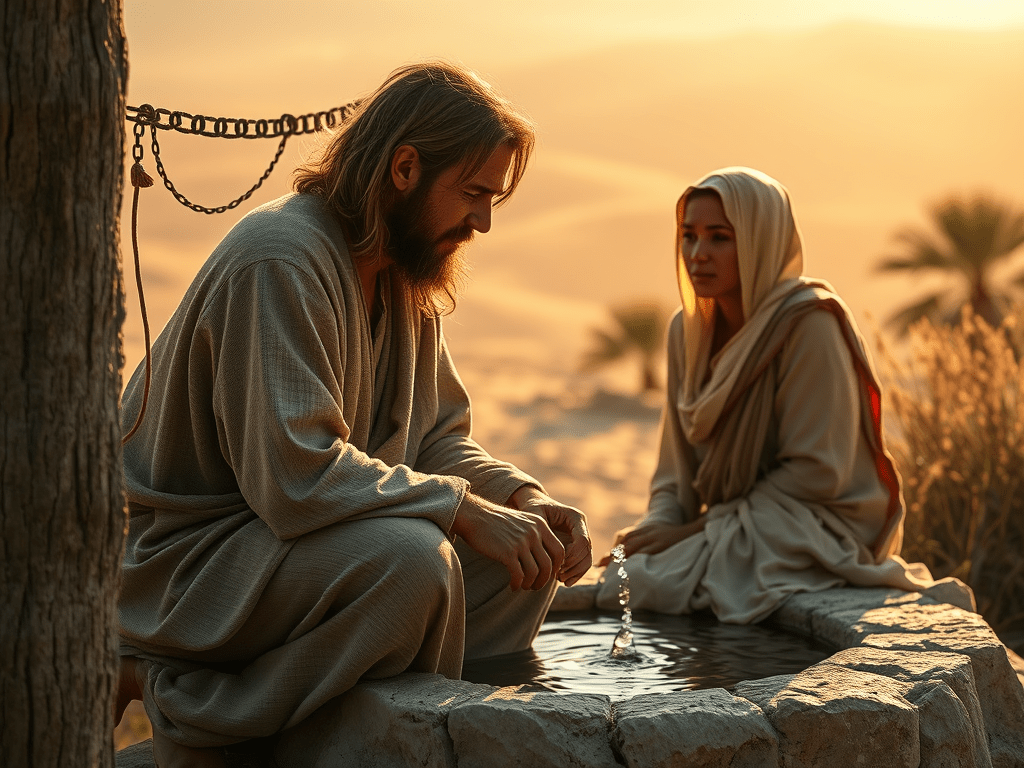
Jesus’ words in John 4 and John 7 paint a powerful picture: he is the one who satisfies the deepest thirst of the human heart, not just once, but as a continual, inner fountain of life.
The Gift of Living Water (John 4:10–14, KJV)
In John 4, Jesus meets a Samaritan woman at a well in the heat of the day. She has come for ordinary water, but Jesus opens a conversation about a very different kind of thirst.
“Jesus answered and said unto her, If thou knewest the gift of God, and who it is that saith to thee, Give me to drink; thou wouldest have asked of him, and he would have given thee living water.” (John 4:10, KJV)
The woman thinks in physical terms—she sees a tired Jewish man with no bucket, sitting beside a deep well. But Jesus is talking about the thirst beneath all other thirsts: the longing for love that does not fail, forgiveness that is real, and a life that has purpose beyond the next errand or relationship.
“Jesus answered and said unto her, Whosoever drinketh of this water shall thirst again:
But whosoever drinketh of the water that I shall give him shall never thirst; but the water that I shall give him shall be in him a well of water springing up into everlasting life.” (John 4:13–14, KJV)
Every earthly “well”—success, romance, comfort, status—leaves us thirsty again. Jesus offers something fundamentally different: a life with God that begins now and stretches into eternity, an inner source that does not run dry. The “living water” he gives is the life of God himself poured into a person, cleansing, refreshing, and renewing them from the inside out.
Rivers in the Heart (John 7:37–39, KJV)
Later, at the Feast of Tabernacles in Jerusalem, Jesus returns to the same image of thirst and water, but turns up the volume. On the climactic “last day” of the feast—when water ceremonies remembered God’s provision in the wilderness—he stands and cries out:
“In the last day, that great day of the feast, Jesus stood and cried, saying, If any man thirst, let him come unto me, and drink.
He that believeth on me, as the scripture hath said, out of his belly shall flow rivers of living water.” (John 7:37–38, KJV)
This time, the promise is not only that the thirsty will be satisfied, but that they will become a source of blessing to others. The person who comes to Jesus and believes does not simply receive a small cup to get them through the day; from deep within (“out of his belly”) will flow “rivers of living water.”
John immediately explains what Jesus means:
“(But this spake he of the Spirit, which they that believe on him should receive: for the Holy Ghost was not yet given; because that Jesus was not yet glorified.)” (John 7:39, KJV)
The “living water” is the Holy Spirit—God’s own presence coming to dwell in believers after Jesus’ death, resurrection, and glorification. The Spirit satisfies the thirst for God, assures us we are loved, convicts us of sin, strengthens us to obey, and then overflows through us in love, service, and witness. Where there was once dryness and self-absorption, there is now a quiet but real stream of life that others can taste.
Taken together, John 4 and John 7 move us from:
- Thirst: “If any man thirst…” (John 7:37, KJV; see also John 4:13–14)
- Receiving: “…let him come unto me, and drink.” (John 7:37, KJV)
- Overflowing: “…out of his belly shall flow rivers of living water.” (John 7:38, KJV)
Jesus doesn’t just quench; he transforms the thirsty into fountains.
How This Looks Today: Daniel’s Story
To see how this plays out in modern life, imagine a man named Daniel.
Daniel is in his mid‑30s, living in a big city, and everything about his life says “busy and successful.” He works long hours in tech, hits the gym, goes out with friends, and posts the highlights online. Yet, when the noise dies down, he feels an ache he can’t quite name. He cycles through new experiences the way people refill a cup—new hobbies, new series to binge, new relationships—but the sense of emptiness always returns.
One Sunday, mostly to please his grandmother who has been praying for him, Daniel agrees to visit her church. He expects to be bored, but the pastor reads from John 7:
“If any man thirst, let him come unto me, and drink.
He that believeth on me, as the scripture hath said, out of his belly shall flow rivers of living water.” (John 7:37–38, KJV)
The words “any man thirst” land on him like a spotlight. He thinks, “That’s me. I have everything I thought I wanted, and I’m still thirsty.” At the end of the service, the pastor also quotes Jesus’ words to the Samaritan woman:
“…whosoever drinketh of the water that I shall give him shall never thirst;
but the water that I shall give him shall be in him a well of water springing up into everlasting life.” (John 4:14, KJV)
For the first time, Daniel considers that his real problem might not be a lack of experiences, but a lack of God. His “wells” have been career, approval, and pleasure—and all of them eventually run dry.
That afternoon, back in his apartment, Daniel does something he has never done before. He sits on the edge of his bed, opens a physical Bible his grandmother gave him years ago, finds John 4 and John 7, and slowly reads the passages again. Then he prays, haltingly:
“Jesus, you said that if anyone thirsts, they should come to you and drink. You said you’d give living water, a well springing up into everlasting life. I’m thirsty. I’ve been drinking from everything else. I don’t fully understand this, but I want what you’re talking about. I believe you died and rose again; I believe you can forgive me and give me this living water. Please do that in me.”
There is no thunder, no vision, no dramatic music. But over the following weeks, something begins to change.
- He starts reading a chapter of the Gospel of John most mornings, asking God to speak. Verses that once seemed old‑fashioned now feel strangely alive.
- Old sins and habits that he shrugged off now bother him. Rather than just feeling guilty, he experiences a new desire to be clean—as if fresh water is washing through parts of his life he never opened before.
- When anxiety and restlessness rise, instead of immediately reaching for his phone or planning another distraction, he finds himself turning to prayer, sometimes just saying, “Lord, you promised living water. I feel dry. Help me.” Often, a quiet peace follows that he can’t explain.
- He notices his posture toward people shifting. The coworker he used to see as competition now becomes someone he prays for. He begins to listen more, to encourage more, to step in when others are overwhelmed. He is surprised to find that caring for others leaves him more full, not more empty.
Months later, a friend confides in Daniel, “I don’t get it. You’re dealing with stress like the rest of us, but you seem… grounded. Less frantic. What changed?” Daniel thinks for a moment and then answers honestly:
“I realized I was thirsty in ways nothing here could fix. I started taking Jesus at his word—coming to him, asking him to forgive me and fill me. It’s like there’s a spring inside now instead of just whatever I can pour in from the outside.”
That’s John 4 and John 7 in real life.
Jesus met Daniel in his thirst, just as he met the woman at the well. Daniel came and “drank” by trusting Christ, admitting his need, and receiving his forgiveness. Over time, the Holy Spirit began to work in him as that promised “well of water springing up into everlasting life” (John 4:14, KJV), and from deep within, “rivers of living water” (John 7:38, KJV) started to flow out in new desires, new peace, and new love for others.
Those ancient words are not just religious poetry. They describe a living invitation: if you are thirsty, you can come to Jesus today, just as you are, and ask him to give you that living water—his own Spirit—so that the story of the woman at the well, the crowds in Jerusalem, and Daniel in his city could also become your story.
Continue in the study of the parables of Jesus:
Discovering the Path of Salvation series by Stephen Luckett
Discover more from Grow Stronger Roots
Subscribe to get the latest posts sent to your email.

 Grow Stronger Roots
One thought on “Jesus and the Gift of Everlasting Life John 4:10-14 and 7:37-39”