Continuing in Jesus Parables in the Book of Mark. If you missed the study in Matthew, you could check it out as well.
Mark 12:1–12 confronts religious pride, reveals God’s patient love, and points us straight to Jesus as God’s beloved Son and rejected cornerstone.
The Parable in the King James Text
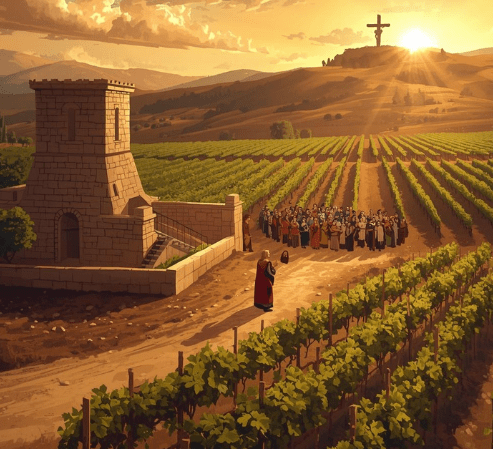
Jesus tells of a “certain man” who plants a vineyard, sets a hedge around it, digs a place for the winefat, builds a tower, and lets it out to husbandmen before traveling to a far country. At harvest time he sends servants to receive “of the fruit of the vineyard,” but the tenants beat one, stone another, and kill others, sending them away empty and shamefully handled. Last of all he sends his “one son, his wellbeloved,” saying, “They will reverence my son,” yet the husbandmen kill him, casting him out of the vineyard, hoping to seize the inheritance. Jesus then asks, “What shall therefore the lord of the vineyard do?” and answers that he will “come and destroy the husbandmen, and will give the vineyard unto others.” He closes with Scripture: “The stone which the builders rejected is become the head of the corner: This was the Lord’s doing, and it is marvellous in our eyes.”
A Story Aimed at Religious Leaders
Mark notes that the chief priests, scribes, and elders “knew that he had spoken the parable against them,” but they feared the people. In the imagery of the parable, the vineyard represents Israel, the tenants are the religious leaders, and the servants are the prophets whom God sent again and again. God had given Israel every spiritual privilege—law, temple, promises—expecting fruit of obedience, justice, and true worship, yet the leaders resisted His messengers. The escalating violence toward the servants mirrors Israel’s history of rejecting, persecuting, and sometimes killing God’s prophets.
The Beloved Son and the Rejected Stone
When Jesus speaks of the “one son, his wellbeloved,” He is identifying Himself as God’s uniquely loved Son, echoing the Father’s voice at His baptism and transfiguration. The tenants’ decision—“This is the heir; come, let us kill him, and the inheritance shall be ours”—foreshadows the leaders’ plot to put Jesus to death and keep control of religious power. Yet Jesus quotes Psalm 118: “The stone which the builders rejected is become the head of the corner,” showing that His rejection will not be the end but the means by which God exalts Him. The same leaders who judge themselves wise “builders” turn away the very cornerstone God has chosen, but the Lord overrules their verdict and sets Christ at the center of His saving plan.
God’s Patience and Final Judgment
The repeated sending of servants reveals an almost shocking patience: the owner does not immediately destroy the wicked tenants, but continues to appeal. This reflects God’s long-suffering heart toward His people, sending prophet after prophet, giving space for repentance, and delaying judgment. Yet the parable also warns that persistent rejection has consequences: the lord of the vineyard will come, destroy the tenants, and give the vineyard to others. In history, this looked like the removal of Israel’s corrupt leadership and the opening of God’s kingdom to all who believe, Jew and Gentile, under the lordship of Christ.
Living the Parable Today
This parable still speaks to churches, leaders, and individual believers who have received much from God. We are stewards, not owners; everything we have—life, gifts, opportunities, congregations—belongs to the Lord, and He rightly looks for fruit that honors Him. We must guard against the attitude of the tenants, clinging to position, reputation, or control instead of gladly submitting to the Son. When the Word of Christ confronts us, the call is to repentance and faith—to receive the rejected yet risen Savior and to let Him reorder the whole “building” of our lives.
Discovering the Path of Salvation series by Stephen Luckett
Discover more from Grow Stronger Roots
Subscribe to get the latest posts sent to your email.

 Grow Stronger Roots
One thought on “Parable of the Wicked Husbandmen: Mark 12:1–12”