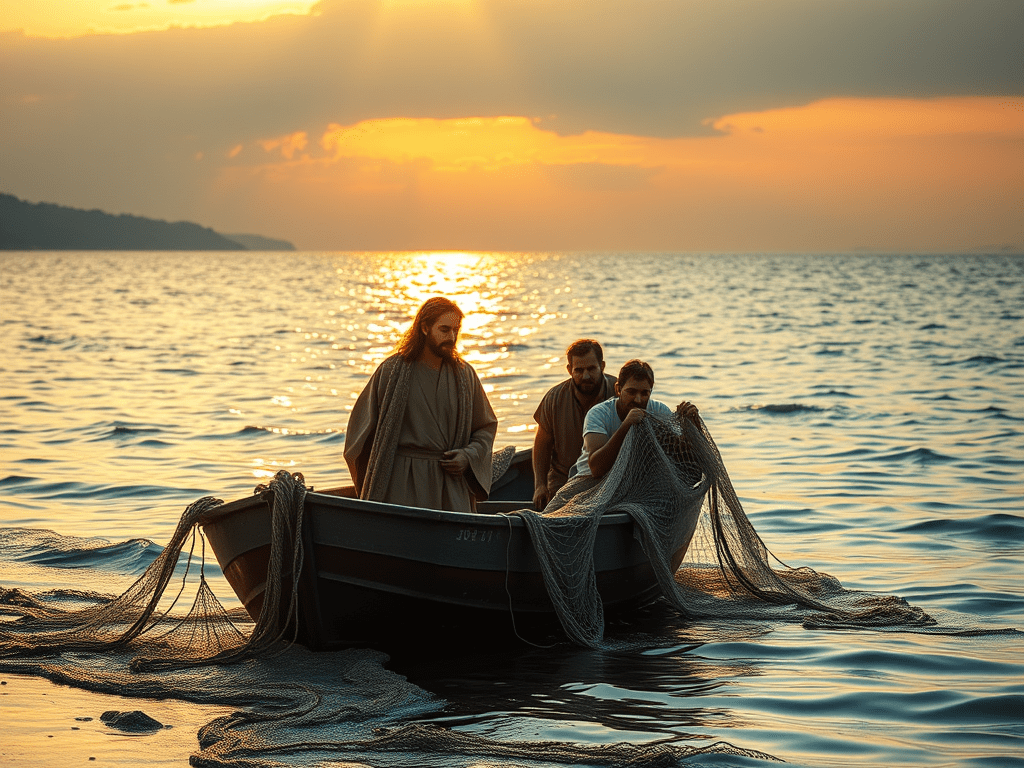
John 21:1–14 is a story of the risen Christ meeting tired, disappointed disciples and turning their empty nets into a feast of grace.
Historical context
This scene takes place after Jesus’ crucifixion and resurrection, likely days or weeks after the events of John 20. The disciples have seen the risen Lord, but they are still uncertain about their future and their calling. Peter, who had denied Jesus three times, is especially marked by failure and shame, even though he has seen the empty tomb and the living Christ.
They are in Galilee, back near the Sea of Tiberias (another name for the Sea of Galilee), the region where many of them first followed Jesus as fishermen. In first-century Galilee, fishing was hard, nightly labor, done with nets and teamwork, and the lake was central to both their livelihood and their memories. It was here Jesus had first called them to be “fishers of men”; now, after the trauma of the cross, they find themselves returning to what they know—back to the boats, back to the nets, back to “normal life,” but with a deep ache in their souls.
An Empty Night
John writes, “After these things Jesus shewed himself again to the disciples at the sea of Tiberias; and on this wise shewed he himself” (John 21:1, KJV). Seven disciples are together: “Simon Peter, and Thomas called Didymus, and Nathanael of Cana in Galilee, and the sons of Zebedee, and two other of his disciples” (John 21:2, KJV). Peter says, “I go a fishing,” and they answer, “We also go with thee” (John 21:3, KJV). It’s not rebellion so much as confusion and instinct—they return to their old work while they wait and wonder what comes next.
They fish all night and catch nothing: “They went forth, and entered into a ship immediately; and that night they caught nothing” (John 21:3, KJV). The emptiness of their nets mirrors the emptiness they feel in themselves—tired, competent men doing what they know best, and still coming up short. They are working in their own strength, and the result is failure.
A Voice on the Shore
“But when the morning was now come, Jesus stood on the shore: but the disciples knew not that it was Jesus” (John 21:4, KJV). Dawn breaks, and the risen Lord is already there, standing on the shoreline of their frustration. Yet they do not recognize Him; grief, distance, and perhaps the dim morning light keep them from seeing who He is.
“Then Jesus saith unto them, Children, have ye any meat? They answered him, No” (John 21:5, KJV). His question forces them to admit their lack. He then gives a simple, specific command: “Cast the net on the right side of the ship, and ye shall find” (John 21:6, KJV). They obey, and “now they were not able to draw it for the multitude of fishes” (John 21:6, KJV). A whole night of human effort yields nothing; one word of Christ, obeyed, fills the net.
“It Is the Lord”
“Therefore that disciple whom Jesus loved saith unto Peter, It is the Lord” (John 21:7, KJV). John recognizes Jesus not by His appearance, but by His unmistakable way of turning emptiness into abundance. When Simon Peter hears that it is the Lord, “he girt his fisher’s coat unto him (for he was naked), and did cast himself into the sea” (John 21:7, KJV). The same Peter who once jumped out of a boat to walk on water toward Jesus now jumps in again, driven not by bravado but by longing to be near Him.
The others follow with the boat, “(for they were not far from land, but as it were two hundred cubits,) dragging the net with fishes” (John 21:8, KJV). Obedience has given them more than they can handle, and they are literally pulling the evidence of Christ’s power behind them as they come to shore.
Breakfast with the Risen Christ
“As soon then as they were come to land, they saw a fire of coals there, and fish laid thereon, and bread” (John 21:9, KJV). Before they bring a single fish from their miraculous catch, Jesus already has fish and bread prepared. He does not need their catch; He invites them to share what He has already provided. Yet He still involves them: “Jesus saith unto them, Bring of the fish which ye have now caught” (John 21:10, KJV).
“Simon Peter went up, and drew the net to land full of great fishes, an hundred and fifty and three: and for all there were so many, yet was not the net broken” (John 21:11, KJV). The specific number underlines the reality and abundance of the miracle—this is no vague spiritual feeling, but a concrete act of provision. Jesus then says, “Come and dine” (John 21:12, KJV). None of the disciples dares ask who He is, “knowing that it was the Lord” (John 21:12, KJV).
“Jesus then cometh, and taketh bread, and giveth them, and fish likewise” (John 21:13, KJV). It is a quiet, intimate moment: the risen Son of God serving breakfast to His weary friends on a beach. John notes, “This is now the third time that Jesus shewed himself to his disciples, after that he was risen from the dead” (John 21:14, KJV). The One who conquered death chooses not to display power with thunder and fire, but to restore and feed His disciples in the simplicity of a shared meal.
Living This Today: A Modern Story
Imagine a man named Daniel. He once walked closely with the Lord—active in church, passionate about sharing his faith, eager in prayer. But over the years, life got complicated. A business venture failed. His marriage grew strained. He made a series of compromises he never thought he’d make, and shame settled over his heart. He still believes, but he feels disqualified and distant, so he pours himself into work, overtime, and constant activity, trying to outrun the emptiness.
One evening, after a long stretch of striving, Daniel sits at his desk long after everyone has gone home. His projects are behind, his inbox is full, and his heart feels even more exhausted than his body. On a whim, he opens a Bible app he hasn’t touched in months, and the passage of the day happens to be John 21:1–14. He reads the words, “and that night they caught nothing” (John 21:3, KJV), and it feels like someone has just summarized his whole year.
He keeps reading and hears Jesus ask, “Children, have ye any meat?” (John 21:5, KJV). In his soul he hears a gentle question: “Daniel, how is all this striving working for you? Are you full—or empty?” He quietly answers in his heart, “Lord, I have nothing.” He reads how Jesus tells them, “Cast the net on the right side of the ship, and ye shall find” (John 21:6, KJV), and he realizes he has been throwing his nets wherever he wants—chasing success, people’s approval, financial security—without really asking Jesus where to cast.
That night, Daniel closes his laptop and prays a simple prayer in the quiet office: “Lord, I’ve been fishing all night in my own strength. Show me where You want me to cast my nets. I want to listen again.” Over the next days, he starts taking small steps of obedience. He sets his alarm a bit earlier to read Scripture and pray before diving into work. He reaches out to a trusted Christian friend and admits honestly where he has failed and drifted. He apologizes to his wife for the ways he has been emotionally absent and asks if they can start praying together, even if it’s just a short prayer before bed.
At first, nothing looks dramatic. But as he continues to “cast” where Jesus is leading—choosing honesty over image in a business decision, choosing time with family over one more late-night email, choosing confession over hiding—he begins to see quiet, surprising fruit. A deal he thought was lost unexpectedly comes through. A conversation with his wife that he feared would explode instead becomes a turning point. A younger colleague asks him, out of the blue, “You’ve seemed different lately—more peaceful. What changed?”
One evening, sitting at the kitchen table with his family laughing around a simple meal, Daniel thinks of that charcoal fire on the shore and the invitation, “Come and dine” (John 21:12, KJV). He realizes that Jesus didn’t just want to fix the disciples’ fishing problem; He wanted to restore their hearts and share fellowship with them. In the same way, Jesus has been meeting Daniel not merely to improve his circumstances but to bring him back into honest, daily fellowship.
To live John 21:1–14 in modern life is to let Jesus meet us on the shoreline of our disappointments and empty efforts. It looks like admitting, “Lord, I’ve caught nothing,” listening for His direction, and obeying even when it seems simple or strange. It means trusting that He already has “fish and bread” prepared—a grace and provision we did not earn—and that He still says, in the quiet places of our ordinary days, “Come and dine.” In that fellowship, our shame is answered, our striving is reoriented, and our empty nets become testimonies of His risen, personal, restoring love.
Continue the study of the parables by Jesus:
Discovering the Path of Salvation series by Stephen Luckett
Discover more from Grow Stronger Roots
Subscribe to get the latest posts sent to your email.

 Grow Stronger Roots
One thought on “The Miraculous Catch: Embracing Grace in John 21:1–14”