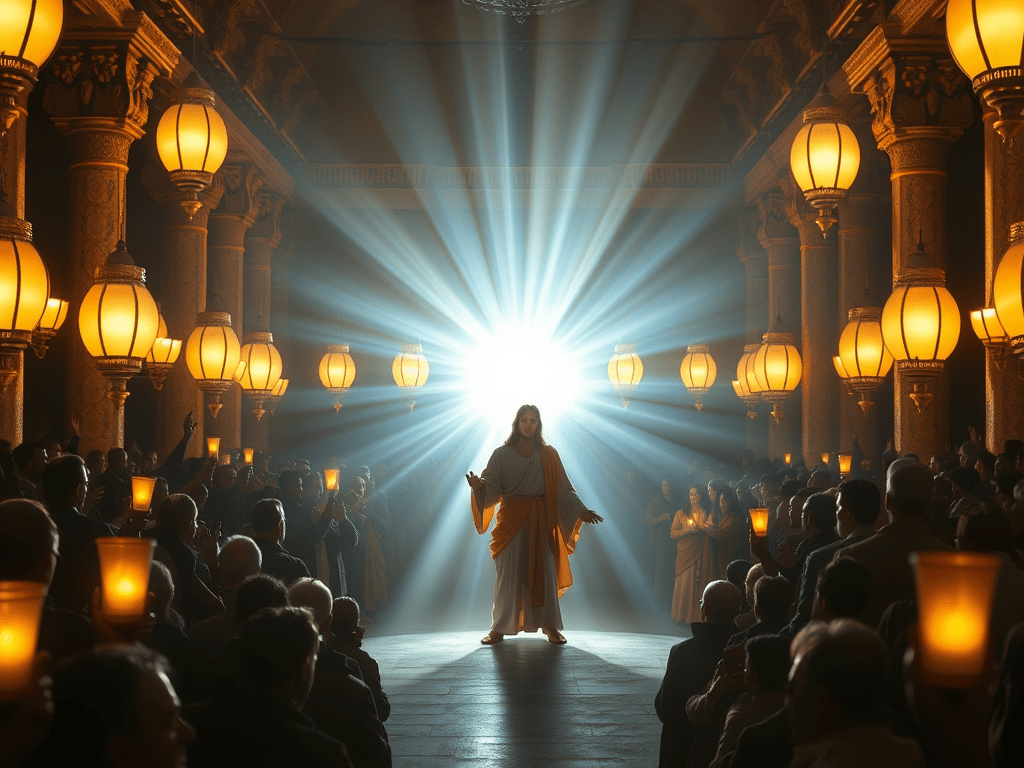
Jesus’ words in John 8:12 and John 12:35–36 are like two scenes in one story: first, he declares who he is; then he presses people to decide what they will do with that revelation.
Scene 1: “I Am the Light of the World” (John 8:12, KJV)
Picture the temple courts in Jerusalem during a great feast, when enormous lamps were lit at night to remind Israel of the pillar of fire that led them through the wilderness. In that setting, Jesus stands and says:
“Then spake Jesus again unto them, saying, I am the light of the world: he that followeth me shall not walk in darkness, but shall have the light of life.” (John 8:12, KJV)
This is not a casual metaphor. In Israel’s Scriptures, only God himself is the guiding, saving light—the one who exposes lies, reveals the path, and protects his people in the night. By claiming to be the light of the world, Jesus is saying that the God who led Israel through the dark desert now stands in front of them in human form, offering guidance, truth, and life to anyone who will follow.
To “walk in darkness” in John’s Gospel is not just about confusion; it is about moral and spiritual lostness, stumbling through life without seeing where you are going or what you are becoming. People may enjoy the cover of darkness because it hides what they would rather not change (compare John 3:19–20, KJV). Jesus’ promise is stunningly simple: if you follow him—trust him enough to let his words and ways set your direction—you will not wander aimlessly in that darkness. Instead, his presence becomes like a lamp in your hands and a sunrise over your horizon: you begin to see God, yourself, and others clearly, and that clarity itself is a kind of life.
Scene 2: “Walk While Ye Have the Light” (John 12:35–36, KJV)
Later in John, the story moves closer to the cross. The crowds have heard Jesus teach, watched him heal, and seen signs that point to his identity. Some are fascinated, some are offended, and many are still undecided. When they ask him more questions about “the Son of man,” Jesus does not give them another lecture; he gives them a warning and an invitation:
“Then Jesus said unto them, Yet a little while is the light with you. Walk while ye have the light, lest darkness come upon you: for he that walketh in darkness knoweth not whither he goeth.
While ye have light, believe in the light, that ye may be the children of light. These things spake Jesus, and departed, and did hide himself from them.” (John 12:35–36, KJV)
If John 8:12 is about who Jesus is, John 12:35–36 is about what people must do in response. Light is no longer just something to admire from a distance; it is something you must walk in or turn away from. Jesus tells them time is short. If they keep hesitating, the darkness will “come upon” them and overtake them—their indecision will harden into unbelief, and they will lose the clarity and opportunity they have in that moment.
The promise deepens: those who believe in the light “may be the children of light.” Light is no longer only outside, leading them; it becomes part of their identity. They belong to God’s family, and his life shines through their character, decisions, and love. The one who once stood before them as “the light of the world” now offers to reproduce that light within them.
One Story: From Revelation to Response
Taken together, these two passages tell a single story:
- Jesus reveals himself: “I am the light of the world: he that followeth me shall not walk in darkness, but shall have the light of life.” (John 8:12, KJV)
- Jesus invites a response: “Walk while ye have the light, lest darkness come upon you… While ye have light, believe in the light.” (John 12:35–36, KJV)
- Jesus promises a new identity: those who believe in the light “may be the children of light.” (John 12:36, KJV)
A practical way to picture it is this: imagine standing at the edge of a forest at night, holding a powerful lantern that shows a narrow but solid path. In John 8, Jesus is saying, “I am that lantern, the only true light.” In John 12, he is saying, “Do not just stand there analyzing the beam—step onto the path while you still see it.” If you keep walking in that light, over time you begin to shine too; his light slowly shapes your thoughts, your loves, and your choices until people can see its glow in you.
How This Looks Today: Elena’s Story
Imagine a woman named Elena.
She works in a busy office, always on, always performing, always scrolling. On paper her life looks fine: stable job, decent apartment, weekends out with friends. But lately she feels like she is moving through a dim room, bumping into the same frustrations over and over—anxiety that spikes at 3 a.m., resentment toward a coworker who undercuts her, a habit of numbing herself with her phone until midnight.
One evening, exhausted, she accepts a friend’s invitation to a small Bible study. They happen to be reading these very words:
“I am the light of the world: he that followeth me shall not walk in darkness, but shall have the light of life.” (John 8:12, KJV)
“Yet a little while is the light with you. Walk while ye have the light, lest darkness come upon you… While ye have light, believe in the light, that ye may be the children of light.” (John 12:35–36, KJV)
At first, Elena just feels seen. “Darkness” suddenly is not an abstract idea; it is her secret bitterness, her quiet dishonesty at work, the quiet ache she hides from everyone. “Light” does not sound like harsh judgment; it sounds like the possibility that someone could actually show her a different way to live.
Nothing magical happens that night. But she does one small, concrete thing: she decides to “walk while [she has] the light.” She goes home, sits on her bed, and prays, “Jesus, if you really are the light of the world, I want to follow you. Show me where I have been walking in the dark, and lead me out.” It is simple, awkward, and honest.
Over the next weeks, that decision quietly reshapes her life.
- She begins each morning with a short prayer and a Gospel passage, asking, “What would it mean to walk in your light today?”
- She senses she needs to address her resentment at work. Instead of gossiping, she has a hard, humble conversation with her coworker and admits where she has been unfair too. It is uncomfortable, but strangely freeing.
- Late at night when anxiety rises, she starts to bring it to Christ instead of to endless scrolling—sometimes just by whispering, “You are the light of the world; I feel very dark right now. Help me see.” Little by little, the panic loosens its grip.
- She notices that as she keeps stepping into truth—telling it, confessing it, acting on it—some of her old habits lose their appeal. The darkness that once felt familiar starts to feel foreign.
Months later, a newer coworker opens up to Elena about feeling lost and ashamed of her own choices. To Elena’s surprise, she finds herself speaking words of hope she did not know she had: “I used to feel like that too. I have started following Jesus, and it is like someone turned a light on in my life.” The coworker comments, “You are different. You are… lighter.”
That is John 8:12 and John 12:35–36 in real time.
Elena met the Light of the world not as an idea, but as a living person who exposed what was hidden without crushing her. She chose to walk while she had that light—making small, costly decisions in the direction of Jesus’ truth rather than her old patterns. And over time, the promise proved true: she began to look like what she followed. She did not become perfect, but she was becoming a “child of light,” someone in whom the character, clarity, and compassion of Christ were starting to shine in an otherwise dim place.
That is how these ancient words still work today: Jesus reveals himself, we respond in trust and obedience one step at a time, and slowly, almost quietly, his light moves from beside us to within us—and then out through us into the lives of others.
Continue in the study of the parables of Jesus:
Discovering the Path of Salvation series by Stephen Luckett
Discover more from Grow Stronger Roots
Subscribe to get the latest posts sent to your email.

 Grow Stronger Roots
One thought on “From Darkness to Light: Understanding John 8:12 and 12:36”