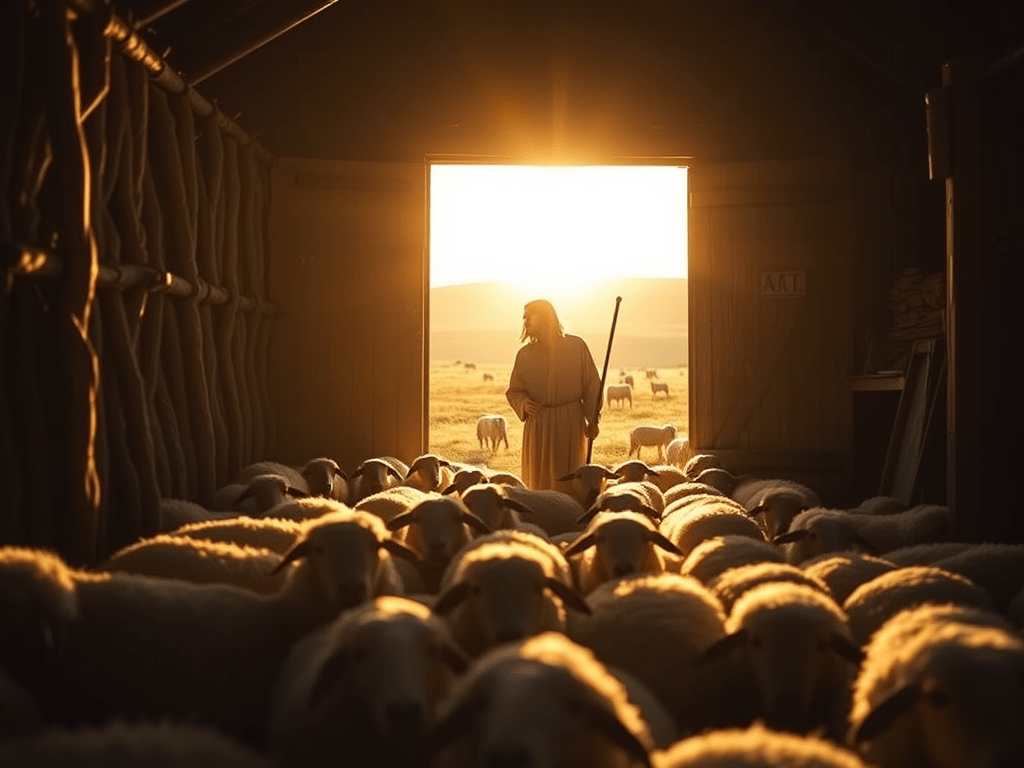
Jesus’ “parable” in John 10:1–18 is less a cute story about sheep and more a bold claim about who he is, what he offers, and whom we can safely trust with our lives (John 10:6 KJV). It invites us to ask: whose voice are we following, and where is it actually leading us (John 10:4–5 KJV)?
The scene: sheep, a pen, and competing voices
In John 10, Jesus describes a common sight in first‑century Palestine: a shared sheepfold where several flocks spend the night, watched by a gatekeeper—“he that entereth in by the door is the shepherd of the sheep… and the sheep hear his voice: and he calleth his own sheep by name, and leadeth them out” (John 10:2–3 KJV). In the morning, each shepherd calls, and only his own sheep come out, recognizing his voice, while “a stranger will they not follow, but will flee from him: for they know not the voice of strangers” (John 10:5 KJV). Anyone climbing over the wall instead of using the gate is obviously an intruder—“a thief and a robber” with no real care for the sheep (John 10:1 KJV).
Then Jesus does something striking: he identifies himself both as the legitimate shepherd who enters through the door and as the very “door of the sheep” itself (John 10:2, 7 KJV). The one who enters through him “shall be saved, and shall go in and out, and find pasture,” enjoying true safety and nourishment (John 10:9 KJV). In contrast, the thief only comes “to steal, and to kill, and to destroy,” but Jesus comes “that they might have life, and that they might have it more abundantly” (John 10:10 KJV).
Jesus as the door: the only way into life
Calling himself the “door” (or gate) is not soft, sentimental language; it’s exclusive and deeply personal—“I am the door: by me if any man enter in, he shall be saved” (John 10:9 KJV). A door both limits and welcomes, keeping out what destroys and admitting what belongs, and by claiming to be the door, Jesus insists that access to God’s flock and care goes through him, not through religious performance, spiritual shortcuts, or self‑salvation projects (John 10:7–9 KJV). Life in the deepest sense—reconciliation with God, security, identity, and eternal hope—comes only by entering through him, the one whom the Father has sent (John 10:9–10, 18 KJV).
In a culture (and church world) full of “other doors”—success, moralism, politics, spirituality without Christ—this image presses a hard question: what am I actually trusting to get me to God, to make me whole, to give me rest (John 10:1, 8 KJV)? Jesus’ answer is unapologetic: “If any man enter in, he shall be saved” through him (John 10:9 KJV). To enter is to trust him—his person, his work, his word—rather than climbing the wall by our own plans (John 10:1 KJV).
Jesus as the good shepherd: known, led, and protected
Jesus doesn’t just offer a doorway; he offers himself as the “good shepherd,” saying, “I am the good shepherd: the good shepherd giveth his life for the sheep” (John 10:11 KJV). That word “good” isn’t just “competent” or “nice,” but noble and worthy, and he is the shepherd every sheep wishes it had, in contrast to the hireling who “seeth the wolf coming, and leaveth the sheep, and fleeth” (John 10:12 KJV).
Several features of his shepherding stand out: he knows his sheep and is “known of mine,” a picture of intimate, mutual knowledge (John 10:14 KJV). His sheep know his voice and follow—“he goeth before them, and the sheep follow him: for they know his voice”—so Christian faith becomes not just assenting to ideas but recognizing and responding to a living Person who speaks (John 10:3–4 KJV). He goes before his sheep; he doesn’t drive from behind but leads from the front into green pasture and even through danger, unlike the hireling who cares not for the sheep (John 10:4, 12–13 KJV).
We often imagine God as distant or as a boss handing down instructions, but this picture is different: a shepherd who walks ahead, takes the first blows, and invites us to keep our eyes and ears fixed on him (John 10:4, 11 KJV).
False shepherds and the thieves who climb the wall
Not everyone who talks about God, truth, or “the good life” is a true shepherd, and Jesus warns about thieves and robbers who slip in other ways (John 10:1, 8 KJV). They avoid the door, meaning they bypass or distort Jesus himself, and they use the flock rather than serving it, showing by their actions that they are hirelings who flee when the wolf comes and the sheep are scattered (John 10:12–13 KJV). Ultimately, such voices leave people emptier, more anxious, more enslaved, because “the thief cometh not, but for to steal, and to kill, and to destroy” (John 10:10 KJV).
In Jesus’ day, this included religious leaders who loved status more than God, but the principle reaches much further, covering any influence that does not bear the marks of the good shepherd’s heart (John 10:1–6 KJV). One practical takeaway is to learn the shepherd’s voice so well that counterfeits become obvious, because the more you immerse yourself in the heart, words, and ways of Jesus, the less appealing and convincing the thieves will sound (John 10:4–5, 27 KJV).
The cross at the center: he lays down his life
At the heart of this whole passage is Jesus’ repeated claim: “The good shepherd giveth his life for the sheep” (John 10:11 KJV). A hired hand runs when danger comes, because the sheep aren’t worth his skin, but the good shepherd does the opposite—he “lay[s] down [his] life for the sheep” (John 10:15 KJV). Notice how intentional Jesus is about this: “No man taketh it from me, but I lay it down of myself… I have power to lay it down, and I have power to take it again” (John 10:18 KJV).
His death is not a tragic accident but a chosen act of love and obedience to the Father—“This commandment have I received of my Father” (John 10:18 KJV). The shepherd’s death, paradoxically, is what gives the sheep abundant life, as he steps between us and everything that would finally destroy us and then takes his life again in resurrection power (John 10:10, 17–18 KJV). When you feel your failures most sharply and shame tells you to hide, this passage says: your shepherd already laid down his life, and he did it knowing you by name (John 10:3, 11 KJV).
One flock, one shepherd: a wide, welcoming fold
Jesus also hints at a global vision: “And other sheep I have, which are not of this fold: them also I must bring… and there shall be one fold, and one shepherd” (John 10:16 KJV). He’s looking beyond the immediate Jewish context to a worldwide people drawn from every culture and background, all gathered under his care as one flock (John 10:16 KJV). For the church, this pushes against cliquishness and cultural pride, reminding us that the Father loves the Son “because I lay down my life, that I might take it again,” not because of our distinctives (John 10:17 KJV).
A church that truly believes in one flock under one shepherd will be marked by deep unity in Christ, even amid diversity of secondary differences, since all have entered by the same door and heard the same voice (John 10:7, 9, 16 KJV).
Listening and following today
How does this “parable” for the first century speak into a twenty‑first century life? John calls it a “parable” (literally, “this parable spake Jesus unto them”) precisely because it invites a response of understanding and trust (John 10:6 KJV).
A few concrete invitations emerge:
- Let Jesus, not your own effort, be your “door,” trusting that “by me if any man enter in, he shall be saved” (John 10:9 KJV).
- Make it your aim to recognize his voice, as the sheep who “know his voice” and follow when he goes before them (John 10:3–4 KJV).
- Follow where he leads, even when the valley is dark, remembering that the good shepherd gives his life for the sheep while the hireling flees (John 10:11–13 KJV).
- Beware voices that use Jesus’ language but don’t reflect his heart, for “all that ever came before me are thieves and robbers: but the sheep did not hear them” (John 10:8 KJV).
- Rest in the security of his sacrifice, knowing that no one took his life from him, but he laid it down and took it again by his own authority (John 10:17–18 KJV).
In the end, John 10:1–18 is an invitation to move from being a religious bystander to being one of the sheep who actually hears, trusts, and follows the shepherd who calls “his own sheep by name, and leadeth them out” (John 10:3 KJV). The question it leaves hanging is simple and searching: whose voice will you follow, and what kind of life will it lead you into—“to steal, and to kill, and to destroy,” or “life… more abundantly” in the care of the good shepherd (John 10:10–11 KJV)?
Continuing the parable studies in the Gospels:
Discovering the Path of Salvation series by Stephen Luckett
Discover more from Grow Stronger Roots
Subscribe to get the latest posts sent to your email.

 Grow Stronger Roots
One thought on “The Good Shepherd and the Door: Hearing Christ’s Voice in John 10:1–18”