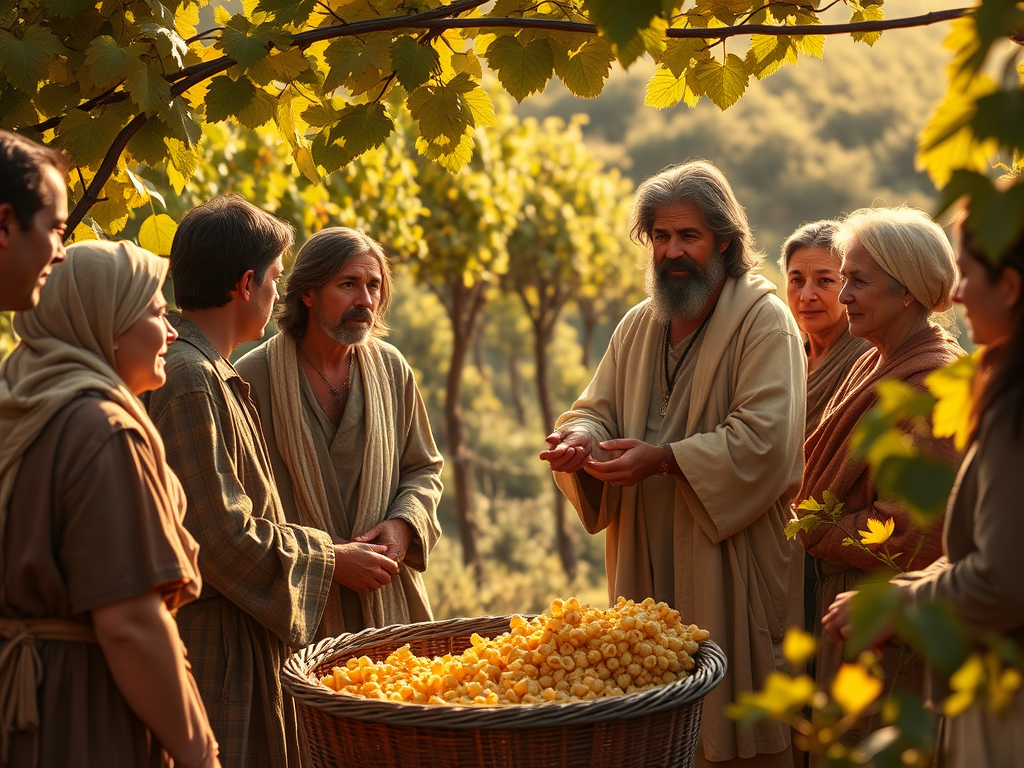
Continuing in the Parables of Jesus in Matthew.
The parable in Matthew 20:1–16 confronts assumptions about fairness, exposes the generosity of God, and challenges the human instinct to measure worth by comparison. Its force comes from the tension between what the laborers expected and what the householder gave.
The Upside‑Down Kingdom
The story opens with a familiar image: a landowner hiring day laborers. Jesus says, “For the kingdom of heaven is like unto a man that is an householder, which went out early in the morning to hire labourers into his vineyard” (Matthew 20:1, KJV). The first group agrees to work for a penny—a denarius, a normal day’s wage.
But the householder keeps returning—at the third hour, sixth, ninth, and even the eleventh hour—inviting more workers. To the later groups he simply says, “Whatsoever is right I will give you” (v. 4).
The surprise comes at payday. Every worker receives the same wage, beginning with the last. Those who worked all day expect more, but when they receive the same penny, they complain: “These last have wrought but one hour, and thou hast made them equal unto us” (v. 12).
The householder’s reply is the heart of the parable: “Friend, I do thee no wrong… Is it not lawful for me to do what I will with mine own? Is thine eye evil, because I am good?” (vv. 13, 15).
Grace That Offends Our Calculations
The early workers weren’t cheated—they received exactly what they agreed to. Their anger came from comparison, not injustice. The parable exposes a human reflex: believing God owes us more because we’ve done more, tried harder, or been faithful longer.
But the kingdom doesn’t run on merit. It runs on grace.
The latecomers picture those who enter God’s kingdom with nothing to boast of—no long record of service, no spiritual résumé. Yet they receive the same life, the same mercy, the same welcome.
This is why Jesus ends with the reversal: “So the last shall be first, and the first last” (v. 16).
In the kingdom, God’s generosity overturns human systems of ranking and reward.
What the Parable Reveals About God
- God is just: He keeps His promises to the first workers.
- God is generous: He gives more than expected to the last.
- God is sovereign: He gives as He wills, not as we calculate.
- God is gracious: He delights to bless those who bring nothing but need.
The householder’s question—“Is thine eye evil, because I am good?”—invites self-examination. Do we rejoice in God’s grace to others, or resent it? Do we serve God for love, or for what we think we should earn?
Living the Parable Today
The parable calls for a posture of gratitude rather than comparison. It invites believers to celebrate every person God draws into His vineyard—whether early in life or at the eleventh hour. It reminds us that salvation is not a wage but a gift.
And it reassures anyone who feels late, behind, or unworthy: in the kingdom of heaven, the invitation still stands. The reward is the same. The generosity is real. The door is open.
Discovering the Path of Salvation series by Stephen Luckett
Discover more from Grow Stronger Roots
Subscribe to get the latest posts sent to your email.

 Grow Stronger Roots
One thought on “Parables of Jesus. Matthew 20:1-16”