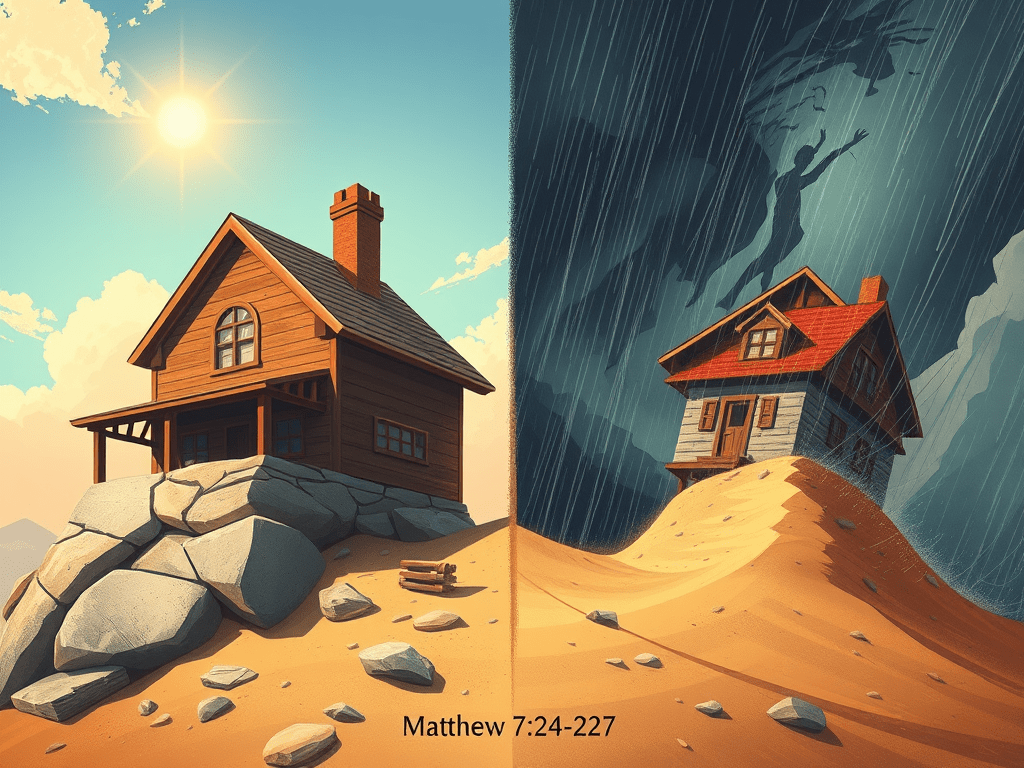
Continuing the study of Jesus Parables in Matthew.
Some teachings of Jesus feel like gentle invitations. Matthew 7:24–27 is not one of them. It lands with the weight of a warning and the clarity of a blueprint. It’s the closing image of the Sermon on the Mount, and Jesus chooses to end His most famous message with a story about construction, storms, and the difference between hearing and doing.
The parable is simple: two builders, two houses, two foundations. One builds on rock. The other builds on sand. Both houses look fine—until the storm comes. Only then does the truth about their foundations become visible.
The Storms Reveal What the Sunshine Hides
One of the most striking aspects of this parable is that both houses face the same storm. Jesus doesn’t say the wise builder avoids hardship. He doesn’t promise that obedience leads to an easier life. Instead, He assumes that storms—literal or metaphorical—are inevitable.
The rain falls. The rivers rise. The winds beat against the house.
Storms don’t create your foundation; they expose it. They reveal whether your life is anchored to something solid or resting on whatever feels convenient in the moment.
Hearing vs. Doing: The Real Divide
Jesus makes a sharp distinction between two kinds of people:
- Those who hear His words and put them into practice
- Those who hear His words and do nothing with them
Both groups hear. Both groups know what Jesus teaches. The difference is not information—it’s transformation.
This is uncomfortable, because it means spiritual maturity isn’t measured by how much we know, how many sermons we’ve heard, or how many verses we can quote. It’s measured by the degree to which Jesus’ teaching shapes our choices, our habits, our relationships, and our reactions.
Obedience, in this parable, is not about rule‑keeping. It’s about alignment. It’s about building your life in a way that matches the reality Jesus describes.
Sand Is Easy. Rock Is Work.
Let’s be honest: building on sand is appealing. It’s quick. It’s flexible. It doesn’t require digging, anchoring, or patience. Building on rock, on the other hand, takes effort. It demands intention. It often means choosing the harder path now to avoid collapse later.
Sand looks like:
- Living by feelings instead of convictions
- Choosing convenience over character
- Chasing approval instead of truth
- Building identity on success, image, or comfort
Rock looks like:
- Forgiving when it’s difficult
- Loving enemies
- Practicing integrity when no one is watching
- Trusting God when circumstances shake
- Living out Jesus’ teachings even when they’re countercultural
Jesus isn’t trying to make life harder. He’s trying to make life stable.
The Quiet Wisdom of Slow, Steady Building
One of the beautiful subtleties of this parable is that the wise builder doesn’t look impressive at first. There’s no applause for digging a deep foundation. No one posts pictures of rebar and bedrock. The early stages of a strong life are often invisible.
But when the storm hits, the hidden work becomes the saving grace.
This is a reminder that spiritual growth is often slow, unglamorous, and unnoticed. It’s formed in daily decisions, small acts of faithfulness, and quiet moments of surrender.
A Foundation That Holds
Ultimately, Jesus is offering more than advice—He’s offering Himself. He is the rock. His teaching is not just moral guidance; it’s an invitation to build your life on the One who doesn’t shift when everything else does.
The parable ends with a collapse “with a great crash,” not to frighten us, but to wake us up. Jesus wants us to build something that lasts—something that can withstand grief, disappointment, temptation, uncertainty, and every storm life brings.
And the good news is that it’s never too late to rebuild. Never too late to reinforce. Never too late to start anchoring your life to something solid.
Discovering the Path of Salvation series by Stephen Luckett.
Discover more from Grow Stronger Roots
Subscribe to get the latest posts sent to your email.

 Grow Stronger Roots
One thought on “Building a Life That Lasts: Reflections on Matthew 7:24–27”