
Over the past five decades (roughly 1975 to 2025), church attendance in the United States has undergone a profound transformation. What was once a cornerstone of American social life—attending religious services weekly or nearly weekly—has seen a steady decline, particularly from the 1990s onward. Yet, recent data suggests this downward trend may be slowing or even stabilizing, with hints of resurgence among younger generations.
The Peak and Early Decline (1970s–1990s)
In the mid-20th century, church attendance was at historic highs. Gallup data from the 1950s showed weekly attendance rates around 49%, with church membership hovering near 70–76%. By the 1970s and 1980s, membership remained relatively stable at about 68–70%, but subtle shifts were underway. Cultural changes, including greater mobility, secular education, and evolving social norms, began eroding regular participation.
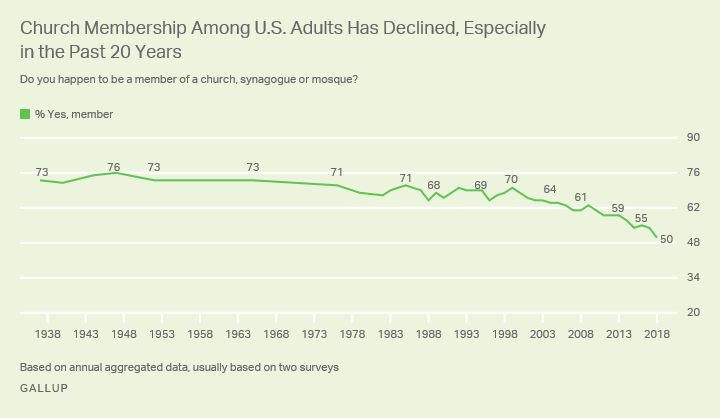
U.S. Church Membership Down Sharply in Past Two Decades
This Gallup chart illustrates the sharp drop in U.S. church membership over recent decades, closely mirroring attendance trends.
Acceleration of Decline (2000s–2010s)
The most dramatic declines occurred in the 21st century. Gallup reports that weekly or nearly weekly attendance fell from about 42% around 2000 to 30% by the early 2020s. Church membership dropped below 50% for the first time in 2020, down from 70% in 1999. Pew Research Center data echoes this, showing monthly attendance declining from 54% in 2007 to around 45% by 2018–2019.
Factors contributing to this include:
- Rise of the religiously unaffiliated (“nones”), growing from under 10% in the 1990s to over 28% today.
- Generational shifts, with younger adults less likely to attend.
- Scandals in religious institutions and polarization tying religion to politics.
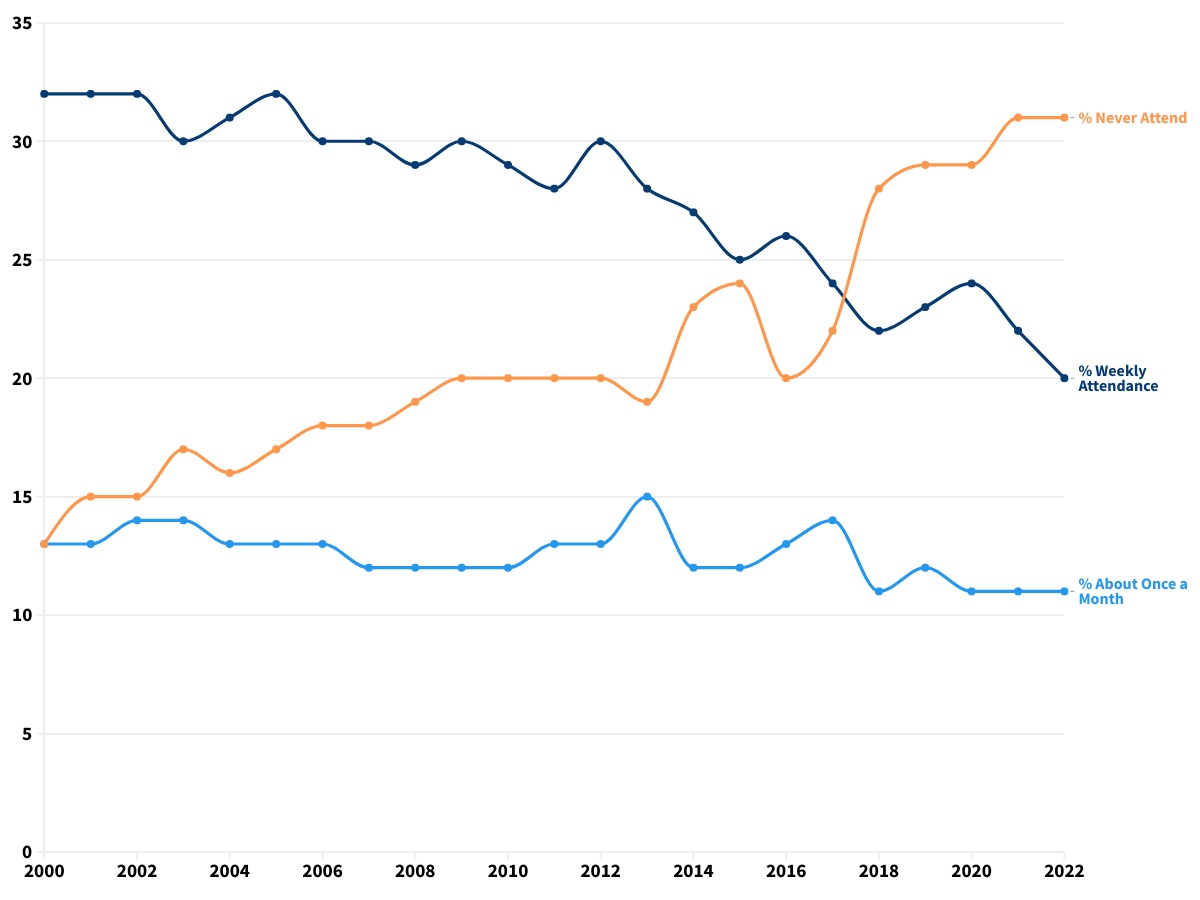

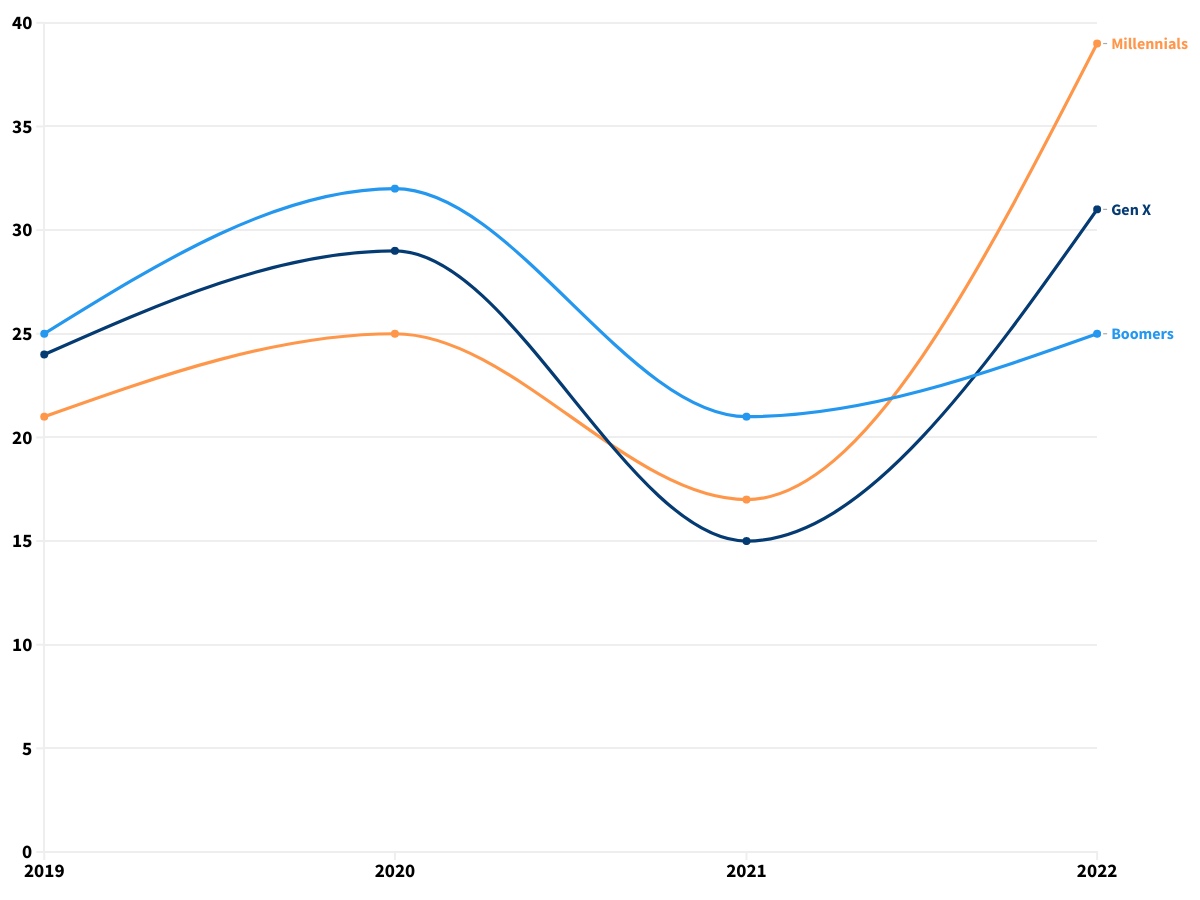
These charts highlight the steady decline in regular attendance and shifts among specific groups like Millennials.
The COVID Era and Recent Signs of Stability (2020–2025)
The COVID-19 pandemic accelerated the drop temporarily, with in-person attendance plummeting. Post-pandemic recovery has been partial—many churches report being at 85% of pre-2020 levels. However, encouraging signs have emerged since around 2020:
- Pew’s 2023–2024 Religious Landscape Study indicates the long-term decline in Christian identification has slowed or leveled off at about 62%.
- Barna and other reports note rising attendance among Millennials and Gen Z, with weekly rates for Millennials increasing from 21% in 2019 to 39% in some surveys.
- Among Gen Z, church membership reportedly rose from 45% to 51% between 2023 and 2024.
Non-denominational and charismatic churches have seen growth, offsetting losses in mainline denominations.
A Global Perspective
While U.S. trends show decline followed by stabilization, global patterns vary. Christianity is growing rapidly in Africa and Latin America through conversions and high birth rates. In Western Europe, attendance has fallen to single digits in many countries over decades. The U.S. remains more religious than most developed nations but follows similar secularization patterns.
What Does the Future Hold?
The past five decades reveal a clear story of decline driven by cultural secularization, but the last few years offer cautious optimism. Younger generations’ renewed interest—possibly spurred by a search for meaning amid isolation and uncertainty—could signal a turning point. Churches adapting with hybrid services, community outreach, and relevant engagement may thrive.
The Future of the Church: A Call to Faithful Obedience
The outlook for the Christian church in America—and indeed worldwide—grows increasingly uncertain without a renewed commitment from believers to step up and fulfill the clear commands Jesus gave us in the Gospels of Matthew and Mark. As Jesus prepared to ascend to heaven, He issued what we know as the Great Commission: “Go therefore and make disciples of all nations, baptizing them in the name of the Father and of the Son and of the Holy Spirit, teaching them to observe all that I have commanded you” (Matthew 28:19-20). In Mark’s account, He declared, “Go into all the world and proclaim the gospel to the whole creation” (Mark 16:15). These aren’t optional suggestions—they’re marching orders for every follower of Christ.
If more Christians don’t take ownership of this mission—actively sharing the gospel, discipling others, and living out our faith boldly—the church’s vitality will continue to wane. We’ve already seen decades of decline in attendance and cultural influence, with empty pews becoming a stark symbol in many congregations.
Yet, this isn’t about chasing massive crowds or building empires. Personally, I’m skeptical of the megachurch model—those sprawling congregations with thousands in attendance, often driven by entertainment, celebrity pastors, and transfer growth from other churches. While some megachurches do faithful work, many prioritize size and spectacle over depth, and recent trends show their explosive growth from decades past has slowed. Instead, I firmly believe that every community needs a solid, Bible-believing and Bible-preaching church—a local body of believers committed to sound doctrine, heartfelt worship, and genuine fellowship.
Local churches are the frontline of God’s kingdom work. They’re where the gospel is proclaimed week after week, where believers are equipped through faithful preaching, and where authentic relationships foster accountability and growth. It’s in these settings that Christians can most effectively live out the Great Commission—sharing the good news in everyday conversations, serving their communities, and making disciples who make disciples.
Recent data offers a mix of caution and hope. While overall church attendance has declined over the past five decades, with many congregations still recovering from pandemic lows, there’s evidence of stabilization—and even resurgence among younger generations like Millennials and Gen Z. Barna reports rising attendance among these groups, with some surveys showing weekly participation nearly doubling in recent years. This could signal a turning point if believers seize the moment.
But stabilization alone isn’t enough. The church’s future isn’t dismal by default—it’s contingent on our obedience. If we return to the basics: preaching the full counsel of God’s Word, prioritizing local community impact over flashy programs, and empowering every believer to evangelize, we can see renewal. Every neighborhood deserves a lighthouse—a Bible-centered church where truth is taught unapologetically, lives are transformed, and the gospel goes forth.
Yet challenges remain: fewer Americans see religion as “very important,” and “nones” continue to grow in some metrics. Whether this stabilization endures will depend on how religious communities respond to a changing society.
Data from Gallup, Pew Research Center, Barna, and Lifeway Research provide the foundation for these insights, reflecting a complex but evolving religious landscape in America.
Discover more from Grow Stronger Roots
Subscribe to get the latest posts sent to your email.

 Grow Stronger Roots