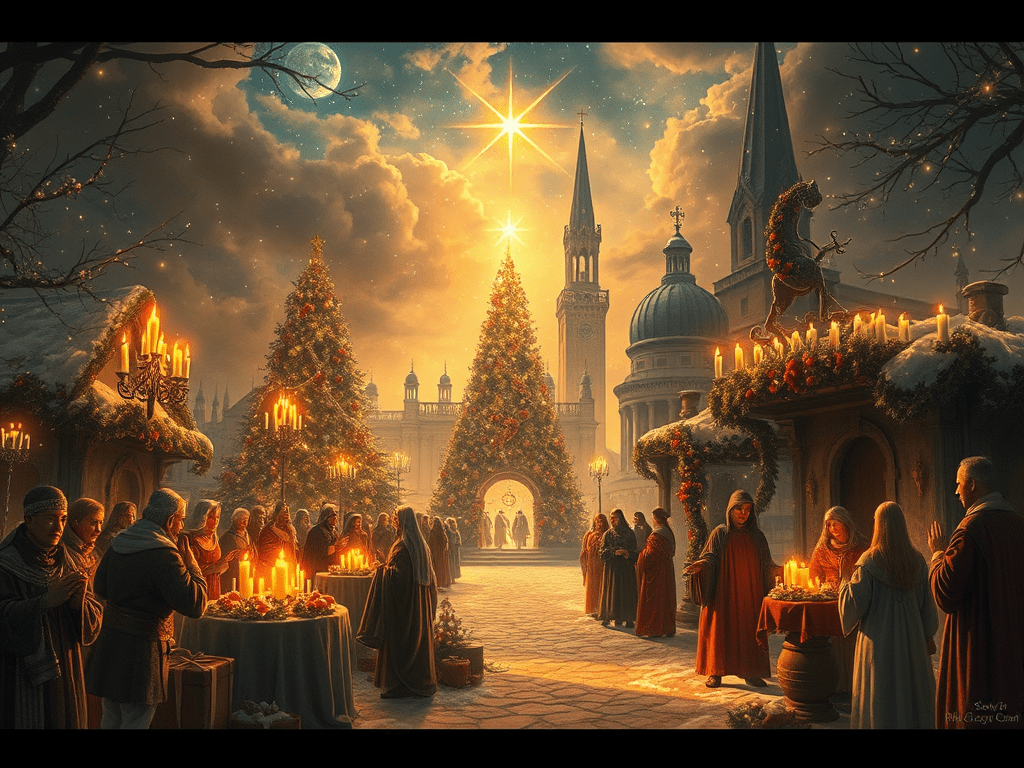
Christmas is so woven into our culture that it feels timelessly appears. Yet the holiday we celebrate on December 25—with trees, lights, gifts, carols, and Santa Claus—took nearly 2,000 years, several continents, and a surprising amount of controversy to reach its modern form.
Here is what I understand to be the true story, told in chronological order.
1st–3rd Centuries: No Christmas Yet
The earliest Christians did not celebrate Jesus’ birth at all. The New Testament never records the date, and the apostolic church focused its calendar on Easter (the death and resurrection). Birthdays in general were viewed with suspicion because pagan emperors celebrated theirs with excessive pomp.
Early church fathers (Origen (c. 245 AD) even mocked the idea of celebrating Christ’s birth as something only pagans and heretics would do.
4th Century: The First Christmas (December 25, 336 AD)
The first recorded celebration of Christ’s birth on December 25 occurred in Rome in AD 336, during the reign of Emperor Constantine. Why December 25?
Two main theories (both probably true):
- The “Calculation Hypothesis” – Early theologians tried to work out the date of Jesus’ conception from the supposed date of Zechariah’s temple service (Luke 1) and the belief that great prophets died on the same day they were conceived. This placed the Annunciation (and thus conception) on March 25, making birth nine months later—December 25.
- The “Christianizing Pagan Festivals” Hypothesis – December 25 was already the Roman feast of Sol Invictus (“Unconquered Sun”), instituted by Emperor Aurelian in 274. Christians may have deliberately chosen the same day to proclaim that Jesus, not the sun, is the true “Light of the World” (John 8:12 KJV).
By 380 AD, Christmas was being celebrated across the Roman Empire from Spain to Syria.
5th–10th Centuries: The Feast Spreads, the Date Is Debated
- The Eastern (Greek-speaking) Church long preferred January 6 (Epiphany) as the day to celebrate both Christ’s birth and baptism.
- Rome stuck with December 25.
- The split lasted centuries; even today the Armenian Christians celebrate Christmas on January 6.
In medieval Europe, Christmas became the biggest feast of the year—twelve days from December 25 to January 6 (the origin of “The Twelve Days of Christmas”).
Middle Ages: Feasting and Misrule
Christmas turned rowdy. The medieval church held the “Feast of the Nativity,” but the streets belonged to carnival-like celebrations:
- Lords of Misrule
- Boy Bishops
- Wassailing
- Massive communal feasts
Puritans in England and New England hated it. In 1647, Parliament actually banned Christmas celebrations, calling them “popish and pagan.” Christmas remained illegal in Massachusetts until 1681 and was widely ignored by Protestants until the 1800s.
19th Century: The Reinvention of Christmas
Modern Christmas was essentially invented between 1820 and 1880:
- 1823 – Clement Clarke Moore’s poem “A Visit from St. Nicholas” (Twas the night before Christmas) created the American image of Santa Claus.
- 1843 – Charles Dickens’ A Christmas Carol turned Christmas into a family-centered festival of generosity and redemption.
- 1860s – German immigrants brought the Christmas tree to America; by 1870 President Ulysses Grant declared Christmas a federal holiday.
- 1870s – Louis Prang of Boston began mass-producing Christmas cards.
- 1880s – Woolworth’s started importing German glass ornaments.
Suddenly, Christmas was domesticated, child-focused, and commercial.
20th Century: Coca-Cola, Rudolph, and Global Export
- 1931 – Coca-Cola’s advertising campaign cemented the modern red-suited Santa (artist Haddon Sundblom).
- 1939 – Robert May wrote Rudolph the Red-Nosed Reindeer as a Montgomery Ward giveaway.
- 1940s–50s – Bing Crosby’s “White Christmas” and televised specials made the holiday inescapable.
- Post-WWII – American-style Christmas spread worldwide via movies, military bases, and consumerism.
Today
December 25 is now observed in almost every country on earth—even in places with tiny Christian populations. Japan, India, and much of the Muslim world celebrate it as a secular winter festival.
I do want to admit that through my study and understanding of scripture, I truly believe that the actual birth is in September. But we have chosen to celebrate His birth on December 25th. Does it really matter? I will not go into the Christmas debate over when its celebrated-since nowhere in the Bible does it tell us to celebrate. We have to just remember the meaning of the celebration.
A Final Thought
Christmas began as a bold theological claim: the eternal Son of God entered history at a specific moment. Over twenty centuries it has absorbed solstice fires, evergreens, gift-giving, reindeer, and elves—yet the ancient creed still rings out every year:
“And the angel said unto them, Fear not: for, behold, I bring you good tidings of great joy, which shall be to all people. For unto you is born this day in the city of David a Saviour, which is Christ the Lord.”
(Luke 2:10–11 KJV)
The date may be debated, the customs may change, but that announcement has never stopped echoing.
Merry Christmas—however and whenever you celebrate it, just remember that the reason for the season remains the same. CELEBRATE JESUS!!
Discover more from Grow Stronger Roots
Subscribe to get the latest posts sent to your email.

 Grow Stronger Roots