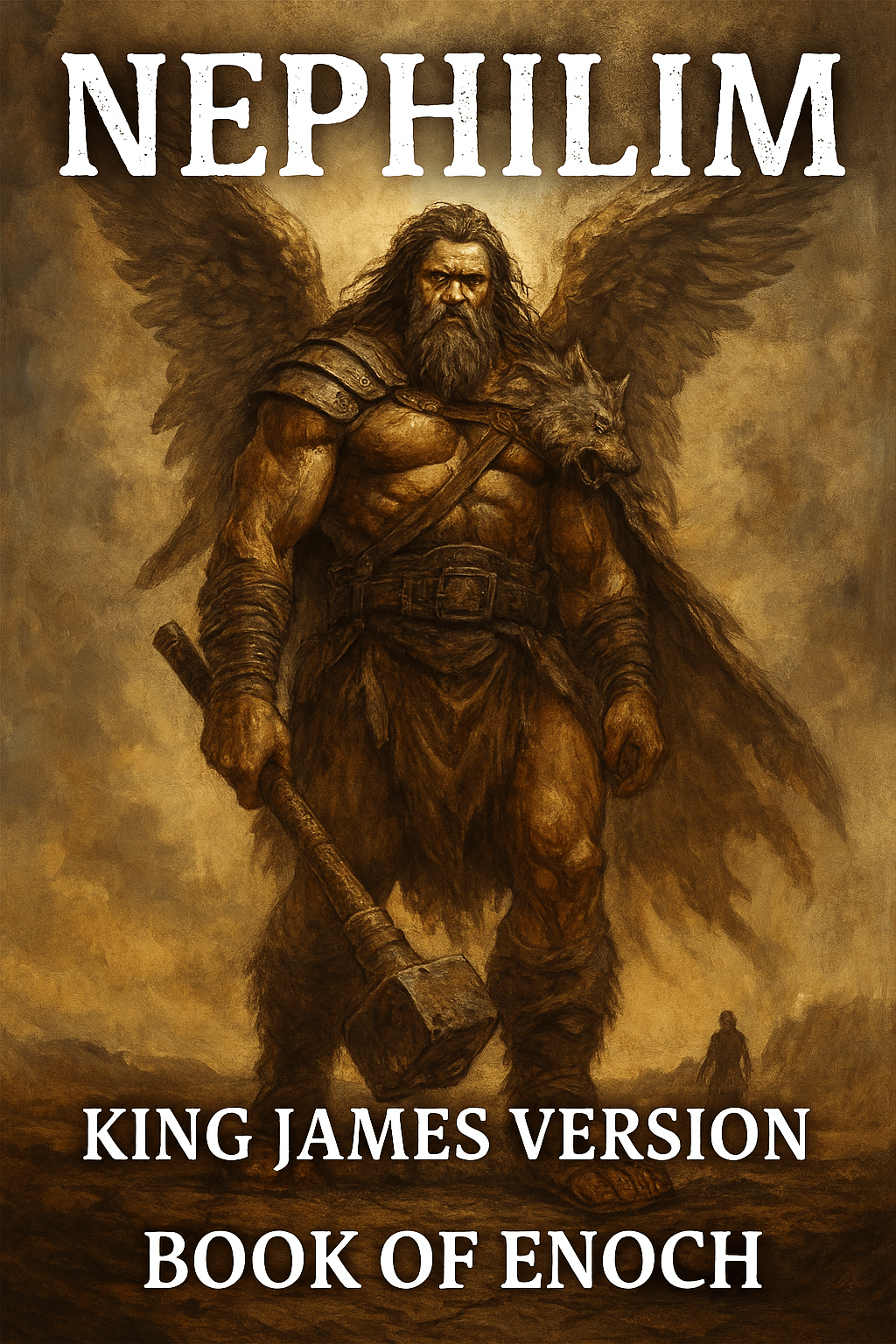
I tend to get distracted by a topic and then dive deeply into it because my mind will keep going down the rabbit hole until I am exhausted. so here is an excerpt of the things I have learned the last few weeks.
The King James Version (KJV) gives a brief, mysterious account of the Nephilim as “giants” born from the union of the “sons of God” and “daughters of men” (Genesis 6:1–4). The Book of Enoch, however, expands this into a vivid narrative: fallen angels called Watchers descend, take human wives, and produce the Nephilim—violent giants whose corruption leads to the Flood.
King James Version (KJV)
- Genesis 6:1–4:
- “Sons of God” saw the “daughters of men” and took them as wives.
- Their offspring were “giants” (Nephilim), described as “mighty men… men of renown.”
- Numbers 13:33: Later Israelites report seeing “giants, the sons of Anak,” linking them to the Nephilim.
- Tone & Detail:
- Very brief and ambiguous.
- No names of angels, no explanation of their sin, and no elaboration on the giants’ behavior.
- Leaves room for interpretation: are “sons of God” angels, divine beings, or simply human rulers?
Nephilim in the Book of Enoch
- 1 Enoch 6–8:
- A group of angels called Watchers descend to earth.
- They lust after human women, take them as wives, and father the Nephilim.
- These giants are described as enormous, violent, and corrupt, consuming humans and spreading bloodshed.
- Names & Details:
- Specific leaders of the Watchers are named (e.g., Semjaza, Azazel).
- Angels also teach forbidden knowledge (sorcery, weapon-making, astrology).
- Moral Framework:
- The Nephilim’s corruption is a direct cause of the Flood.
- God sends archangels (Michael, Gabriel, Raphael, Uriel) to punish the Watchers and destroy the Nephilim.
- Tone & Detail:
- Highly mythological and apocalyptic.
- Provides a cosmic backstory to human wickedness before Noah.
Key Comparisons
| Aspect | KJV (Genesis, Numbers) | Book of Enoch |
|---|---|---|
| Length | Brief (few verses) | Extensive (chapters) |
| Identity of “sons of God” | Ambiguous | Explicitly fallen angels (Watchers) |
| Nephilim description | Giants, “mighty men of renown” | Gigantic, violent, cannibalistic beings |
| Cause of Flood | Human wickedness broadly | Direct corruption by Nephilim and Watchers |
| Names/details | None | Many angelic names, detailed sins |
| Canon status | Canonical in Bible | Non-canonical (except Ethiopian Orthodox) |
Contrast in Purpose
- KJV: Presents the Nephilim as a mysterious backdrop to human wickedness before the Flood.
- Book of Enoch: Offers a theological explanation—fallen angels corrupted creation, necessitating divine judgment.
In short: The KJV leaves the Nephilim as enigmatic “giants,” while the Book of Enoch transforms them into a central drama of angelic rebellion, forbidden knowledge, and divine punishment.
Early Jewish & Christian Interpretations
- Jewish tradition:
- Rabbinic writings often debated whether “sons of God” were angels or human rulers.
- Some leaned toward a more human interpretation to avoid angelic scandal.
- Early Christians:
- Writers like Justin Martyr and Irenaeus accepted the Book of Enoch’s angelic reading, seeing the Watchers as proof of demonic corruption.
- Tertullian even argued Enoch should be considered Scripture because it explained Genesis.
- Others, like Augustine, rejected the angelic view, preferring to see “sons of God” as descendants of Seth (the godly line) mixing with Cain’s line.
Medieval & Renaissance Thought
- Augustine’s influence: His “Sethite” interpretation dominated Western Christianity for centuries, minimizing the angelic rebellion.
- Mystical traditions: Kabbalistic and esoteric writings sometimes revived the Enochian version, linking Nephilim to cosmic mysteries and fallen angels.
- Art & literature: Medieval art rarely depicted Nephilim directly, but Renaissance thinkers rediscovered Enoch and began speculating again about angelic unions.
Reformation & Modern Christianity
- Protestant Reformers: Generally stuck with the canonical KJV account, treating Enoch as apocryphal.
- Modern Evangelicals: Some embrace the Enochian narrative, especially in apocalyptic or “end times” theology, seeing parallels between ancient angelic corruption and modern demonic activity.
- Mainline traditions: Often prefer the symbolic Sethite reading, focusing on human sin rather than angelic rebellion.
Cultural Legacy
- Literature & film:
- The Enochian version inspired fantasy and horror genres (fallen angels, giants, forbidden knowledge).
- The KJV’s vagueness gave rise to mystery and speculation, fueling conspiracy theories and popular culture (e.g., Nephilim as aliens).
- Theological debates:
- The contrast between the sparse KJV and the elaborate Enoch shows how interpretive gaps in Scripture invite myth-making.
- Enoch’s vivid narrative gave later writers a ready-made mythos, while the KJV kept things enigmatic.
Big Picture:
- The KJV Nephilim are mysterious giants, leaving interpretation open.
- The Enoch Nephilim are part of a cosmic drama of angelic rebellion, corruption, and divine judgment.
- Later traditions oscillated between these: Augustine’s human-focused Sethite reading vs. apocalyptic writers who embraced Enoch’s angelic rebellion.
Disclaimer: Although, as most of you know I study the KJV as my go to Bible but use other bibles to aid in my full understanding-BUT I also will use books that are outside the Bible to gain other insight or historical context. I believe you have to be open minded to a point, without compromising understanding and belief of Biblical text. I have read many other non-biblical texts like Enoch, Thomas, and the complete Apocrypha.
Be sure to check out my books for further study.
Discover more from Grow Stronger Roots
Subscribe to get the latest posts sent to your email.

 Grow Stronger Roots